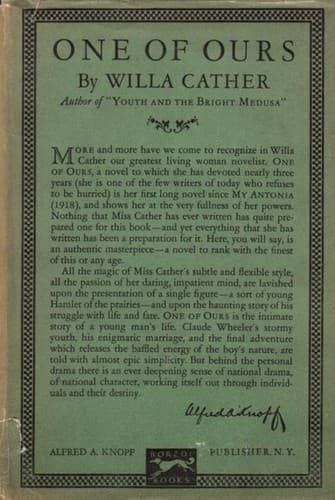
Farm life -- Fiction; Nebraska -- Fiction; Soldiers -- Fiction; War stories; World War, 1914-1918 -- Fiction
Claude was so sleepy that he did not wait for his mother's
return. He stumbled upstairs and undressed in the dark. The night
was sultry, with thunder clouds in the sky and an unceasing play
of sheet-lightning all along the western horizon. Mosquitoes had
got into his room during the day, and after he threw himself upon
the bed they began sailing over him with their high, excruciating
note. He turned from side to side and tried to muffle his ears
with the pillow. The disquieting sound became merged, in his
sleepy brain, with the big type on the front page of the paper;
those black letters seemed to be flying about his head with a
soft, high, sing-song whizz.
VIII
Late in the afternoon of the sixth of August, Claude and his
empty wagon were bumping along the level road over the flat
country between Vicount and the Lovely Creek valley. He had made
two trips to town that day. Though he had kept his heaviest team
for the hot afternoon pull, his horses were too tired to be urged
off a walk. Their necks were marbled with sweat stains, and their
flanks were plastered with the white dust that rose at every
step. Their heads hung down, and their breathing was deep and
slow. The wood of the green-painted wagon seat was blistering hot
to the touch. Claude sat at one end of it, his head bared to
catch the faint stir of air that sometimes dried his neck and
chin and saved him the trouble of pulling out a handkerchief. On
every side the wheat stubble stretched for miles and miles.
Lonely straw stacks stood up yellow in the sun and cast long
shadows. Claude peered anxiously along the distant locust hedges
which told where the road ran. Ernest Havel had promised to meet
him somewhere on the way home. He had not seen Ernest for a week:
since then Time had brought prodigies to birth.
At last he recognized the Havels' team along way off, and he
stopped and waited for Ernest beside a thorny hedge, looking
thoughtfully about him. The sun was already low. It hung above
the stubble, all milky and rosy with the heat, like the image of
a sun reflected in grey water. In the east the full moon had just
risen, and its thin silver surface was flushed with pink until it
looked exactly like the setting sun. Except for the place each
occupied in the heavens, Claude could not have told which was
which. They rested upon opposite rims of the world, two bright
shields, and regarded each other, as if they, too, had met by
appointment.
Claude and Ernest sprang to the ground at the same instant and
shook hands, feeling that they had not seen each other for a long
while.
"Well, what do you make of it, Ernest?"
The young man shook his head cautiously, but replied no further.
He patted his horses and eased the collars on their necks.
"I waited in town for the Hastings paper," Claude went on
impatiently. "England declared war last night."
"The Germans," said Ernest, "are at Liege. I know where that is.
I sailed from Antwerp when I came over here."
Public-domain text, read in full here on John Shaqi.
Reviews
Reviews
No reviews yet
Be the first to share your thoughts on this work.
Elsewhere in the archive
Join the Discussion
Join the discussion
Sign in to leave a comment or review.
Sign InorCreate an account