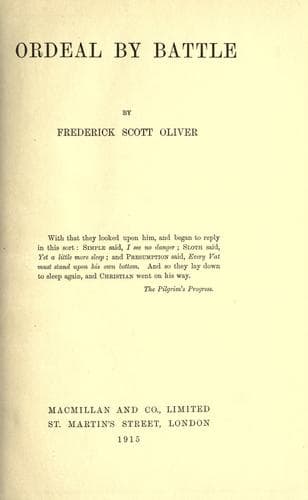
Draft -- Great Britain; Great Britain -- Defenses; World War, 1914-1918
When the crisis occurred in July 1914, when Germany proceeded to
action, when events took place which for years past had been foretold
and discussed very fully on both sides of the North Sea, it was as if a
bolt had fallen from the blue. Uncertainty was apparent in all
quarters. The very thing which had been so often talked of had
happened. Germany was collecting her armies and preparing to crush
France. The neutrality of Belgium was threatened. Yet up to, and on,
Sunday, August 2, there was doubt and hesitation in the Cabinet, and
until some days later, also in Parliament and the country.[5]
When, finally, it was decided to declare war, the course of action
which that step required still appears to have remained obscure to our
rulers. Until the Thursday following it was not decided to send the
Expeditionary Force abroad. Then, out of timidity, only two-thirds of
it were sent.[6] Transport arrangements which were all ready for
moving the whole force had to be hastily readjusted. The delay was
{236} not less injurious than the parsimony; and the combination of the
two nearly proved fatal.
If the minds of the people and their leaders were not prepared for what
happened, if in the moral sense there was unreadiness; still more
inadequate were all preparations of the material kind--not only the
actual numbers of our Army, but also the whole system for providing
expansion, training, equipment, and munitions. It is asking too much
of us to believe that events could have happened as they did in England
during the fortnight which followed the presentation of the Austrian
Ultimatum to Servia, had the Committee of Imperial Defence and its
distinguished president taken pains beforehand to envisage clearly the
conditions and consequences involved in their policy of 'Security.'
As regards naval preparations, things were better indeed than might
have been expected, considering the vagueness of ideas in the matter of
policy. We were safeguarded here by tradition, and the general idea of
direction had been nearly sufficient. There was always trouble, but
not as a rule serious trouble, in establishing the case for increases
necessary to keep ahead of German efforts. There had been pinchings
and parings--especially in the matter of fast cruisers, for lack of
which, when war broke out, we suffered heavy losses--but except in one
instance--the abandonment of the Cawdor programme--these had not
touched our security at any vital point.
Thanks largely to Mr. Stead, but also to statesmen of both parties, and
to a succession of Naval Lords who did not hesitate, when occasion
required it, to risk their careers (as faithful servants ever will)
rather than certify safety where they saw danger--thanks, {237}
perhaps, most of all to a popular instinct, deeply implanted in the
British mind, which had grasped the need for supremacy at sea--our
naval preparations, upon the whole, had kept abreast of our policy for
nearly thirty years.
Public-domain text, read in full here on John Shaqi.
Reviews
Reviews
No reviews yet
Be the first to share your thoughts on this work.
Elsewhere in the archive
Join the Discussion
Join the discussion
Sign in to leave a comment or review.
Sign InorCreate an account