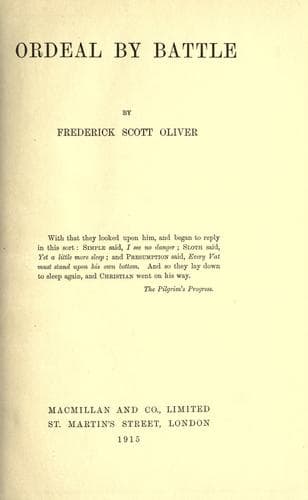
Draft -- Great Britain; Great Britain -- Defenses; World War, 1914-1918
We had curtailed our shipbuilding programme and slowed down our
preparations. Thereby we had hoped to induce Germany to follow suit.
But the effect had been precisely the opposite: she had increased her
programme and speeded up her preparations. At last our Government
became alive to what was going on, and in tones of reverberant anxiety
informed an astonished nation that the naval estimates called for large
additions.
Ministers, indeed, were between the devil and the deep sea. The
supremacy of the British Fleet was menaced; the conscience of the
Radical party was shocked--shocked not so much at the existence of the
menace as at official recognition of it, and at the cost of insuring
against it. It was so much shocked, indeed, that it took refuge in
incredulity; and--upon the strength of assurances which were of course
abundantly forthcoming from the German Admiralty, who averred upon
their honour that there had been neither addition nor
acceleration--roundly accused its own anointed ministers of bearing
false witness against an innocent neighbour.
{282}
None the less, large sums were voted, and the Dominions came forward
with generous contributions.
Sir Wilfrid Laurier, indeed, who had been nourished and brought up on a
diet of dried phrases, was sceptical. To this far-sighted statesman
there appeared to be no German menace either then or subsequently. The
whole thing was a mere nightmare, disturbing the innocent sleep of
Liberalism and democracy.[4]
This was the _second_ warning.
[Sidenote THE THIRD WARNING]
The _third_ warning came in the form of subterranean rumblings,
inaudible to the general public, but clearly heard by ministerial ears.
In July 1909, while the Imperial Conference on Defence was in session,
Herr von Bethmann-Hollweg succeeded Prince Bülow as German Chancellor.
Up to that time there had been the menace of the mailed fist, the
rattling sabre, and the shining armour. Henceforward there was the
additional menace of a diplomacy playing for time, with a careless and
unconcealed contempt for the intelligence, the courage, and the honour
of the British people and their statesmen.[5] The German Government
had clearly formed the opinion that our ministers were growing more and
more afraid of {283} asking their party to support increased naval
estimates, and that it was only necessary to go on, alternately
dangling and withdrawing illusory proposals for a naval understanding
and a general agreement, in order to steal ahead of us in the race.
Here, as in many other instances, the Germans had observed not
altogether incorrectly; but they had drawn the wrong inference from the
facts.
Public-domain text, read in full here on John Shaqi.
Reviews
Reviews
No reviews yet
Be the first to share your thoughts on this work.
Elsewhere in the archive
Join the Discussion
Join the discussion
Sign in to leave a comment or review.
Sign InorCreate an account