Draft -- Great Britain; Great Britain -- Defenses; World War, 1914-1918
We may pause at this breathing-place to take note of the healing
influences of time. Radical journalists of 1832, and thereabouts, were
wont to say very much the same hard things of the Duke of Wellington,
as those of 1912 saw fit to apply to Earl Roberts.... We may also
remark in passing, upon the errors to which even the most brilliant of
contemporary judgments are liable. There has never been a man in our
time who set a higher value on peace than Lord Roberts did. He
realised, however, not only the intrinsic value of peace, but its
market cost. His real crime, in the eyes of pacifists, was that he
stated publicly, as often as he had the chance, what price we must be
prepared to pay, if we wanted peace and not war. It was in this sense,
no doubt, that he did not know 'how to estimate and bow to the
governing forces of national policy.' His blunt warnings broke in
rudely and crudely upon the comfortable discourse of the three
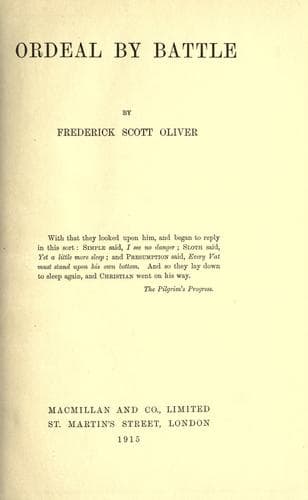
counsellors--_Simple_, _Sloth_, and _Presumption_, who, better than any
others, were skilled in estimating the 'governing forces,' and the
advantages to be gained by bowing to them.
{338}
The writer in the _Nation_ then proceeded to riddle Lord Roberts's
theories of defence. "He desires us to remain a 'free nation' in the
same breath that he invites us to come under the yoke of
conscription"--intolerable, indeed, that the citizens of a free nation
should be ordered to fit themselves for defending their common
freedom--"conscription, if you please, for the unheard-of purpose of
overseas service in India and elsewhere...." This invitation does not
seem to be contained in this, or any other of Lord Roberts's speeches;
but supposing it to have been given, it was not altogether
'unheard-of,' seeing that, under the law of conscription prevalent (for
example) in Germany, conscript soldiers can be sent to Palestine, or
tropical Africa as lawfully as into Luxemburg, Poland, or France.
According to the _Nation_, the true theory of defence was Sea Power;
but this, it appeared, could not be relied on for all time.... "While
our naval monopoly--like our commercial monopoly--cannot exist for
ever, our sea power and our national security depend on our ability to
crush an enemy's fleet.... We were never so amply insured--so
over-insured--against naval disaster as we are to-day."
[Sidenote: A LIBERAL ATTACK]
Public-domain text, read in full here on John Shaqi.
Reviews
Reviews
No reviews yet
Be the first to share your thoughts on this work.
Elsewhere in the archive
Join the Discussion
Join the discussion
Sign in to leave a comment or review.
Sign InorCreate an account