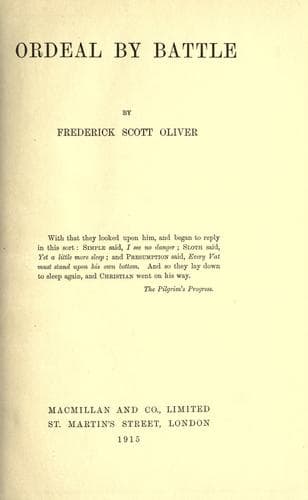
Draft -- Great Britain; Great Britain -- Defenses; World War, 1914-1918
appointment of Lord Kitchener on the 6th of August, will no doubt prove
to be one of the most interesting in our annals. Whether it will prove
to be one of the most glorious or one of the most humiliating
exhibitions of British statesmanship we cannot say until we possess
fuller knowledge than we do at present of the attitude of ministers at
the Cabinets of Friday, Saturday, and Sunday (July 31, August 1 and 2).
[3] Palestine, 1874-1878; Cyprus, 1878-1882; Egypt, 1882-1899; South
Africa, 1899-1902; India, 1902-1909; Egypt, 1911-1914. Only during the
years 1871-1874 and 1909-1911 does Lord Kitchener appear to have been
freed from foreign service, and during a part of the latter interval he
was travelling in China and Japan.
[4] End of May 1915.
{358}
CHAPTER V
MATERIAL OF WAR
As regards the business world the position at this time[1] was a
singularly difficult one. Within a few days of the outbreak of war,
orders from all parts of the globe were forthcoming, on so vast a scale
that the ordinary means of coping with them were wholly inadequate. It
was not possible to walk out of the War Office and buy what was wanted
in the shops. In a very brief period the whole industrial system of
the United Kingdom was congested with orders.
In Lord Kitchener's former experience of military and civil
administration the difficulty had usually been to get the money he
needed, in order to carry out his reforms and undertakings. But here
was a case where he could have all the money he chose to ask for; it
was the commodities themselves which could not be had either for money
or love.
[Sidenote: ORGANISATION OF RESOURCES]
When war broke out the industries of France and Belgium were
paralysed--the former temporarily, the latter permanently. We could
buy nothing in France; France, on the other hand, was buying eagerly in
England. And so was Russia, not herself as yet a great industrial
producer. And so were Belgium, {359} Servia, Italy, Roumania, Greece,
Japan--indeed the whole world, more or less--belligerents and neutrals
alike--except the two Powers with which we were at war. All these
competitors were in the field against the War Office, running up
prices, and making the fortunes of enterprising middlemen, who flocked
to the feast, like vultures from all corners of the sky. The
industrial situation, therefore, needed the sternest regulation, and
needed it at once. For it was essential to secure our own
requirements, and to make certain that our Allies secured theirs, at a
fair price and in advance of all other purchasers.
Public-domain text, read in full here on John Shaqi.
Reviews
Reviews
No reviews yet
Be the first to share your thoughts on this work.
Elsewhere in the archive
Join the Discussion
Join the discussion
Sign in to leave a comment or review.
Sign InorCreate an account