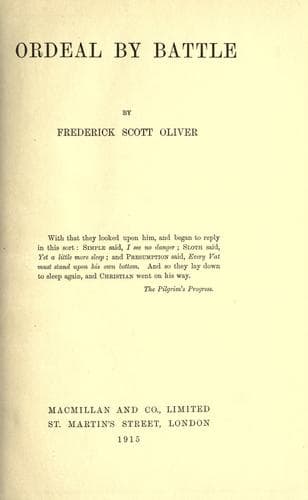
Draft -- Great Britain; Great Britain -- Defenses; World War, 1914-1918
From the national point of view, it is ennobling that at some period of
their lives the great majority of citizens should have served the
commonwealth disinterestedly. This after all is the only principle
which will support a commonwealth. For a commonwealth will not stand
against the shocks, which history teaches us to beware of, merely by
dropping papers, marked with a cross, into a ballot-box once every five
years, or even oftener. It will not stand merely by taking an
intelligent interest in events, by attending meetings and reading the
newspapers, and by indulging in outbursts of indignation or enthusiasm.
It will only stand by virtue of personal service, and by the readiness
of the whole people, generation by generation, to give their lives
and--what is much harder to face--the time and irksome preparation
which are necessary for making the {407} sacrifice of their
lives--should it be called for--effective for its purpose.
If the mass of the people, even when they have realised the need, will
not accept the obligation of national service they must be prepared to
see their institutions perish, to lose control of their own destinies,
and to welcome another master than Democracy, who it may well be, will
not put them to the trouble of dropping papers, marked with a cross,
into ballot-boxes once in five years, or indeed at all. For a State
may continue to exist even if deprived of ballot-boxes; but it is
doomed if its citizens will not in time prepare themselves to defend it
with their lives.
The memories of the press-gang and the militia ballot are dim. Both
belong to a past which it is the custom to refer to with reprobation.
Both were inconsistent with equal comradeship between classes; with
justice, dignity, honour, and the unity of the nation; and on these
grounds they are rightly condemned.
But the press-gang and the militia ballot have been condemned, and are
still condemned, upon other grounds which do not seem so firm. Both
have been condemned as contravening that great and laudable principle
of British freedom which lays it down that those who like fighting, or
prefer it to other evils--like starvation and imprisonment--or who can
be bribed, or in some other way persuaded to fight, should enjoy the
monopoly of being 'butchered,' both abroad and at home. And it has
been further maintained by those who held these views, that people who
do not like fighting, but choose rather to stay at home talking,
criticising, enjoying {408} fine thrills of patriotism, making money,
and sleeping under cover, have some kind of divine right to go on
enjoying that form of existence undisturbed. Since the Wars of the
Roses the latter class has usually been in a great majority in England.
Even during the Cromwellian Civil War the numbers of men, capable of
bearing arms, who actually bore them, was only a smallish fraction of
the entire population.
Public-domain text, read in full here on John Shaqi.
Reviews
Reviews
No reviews yet
Be the first to share your thoughts on this work.
Elsewhere in the archive
Join the Discussion
Join the discussion
Sign in to leave a comment or review.
Sign InorCreate an account