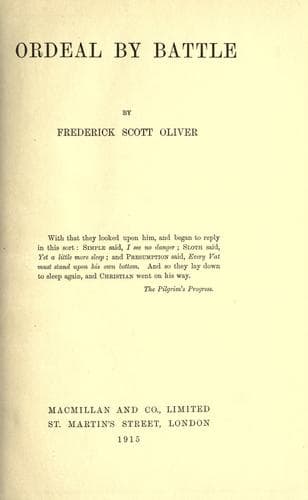
Draft -- Great Britain; Great Britain -- Defenses; World War, 1914-1918
The moral ideals of any community, like other things, are apt to be
settled by numbers. With the extension of popular government, and the
increase of the electorate, this tendency will assert itself more and
more. But providing the people are dealt with plainly and frankly,
without flattery or deceit--like men and not as if they were greedy
children--the moral sense of a democracy will probably be sounder and
stronger than that of any other form of State.
Even in England, however, there have been lapses, during which the
people have not been so treated, and the popular spirit has sunk, owing
to mean leadership, into degradation. During the whole of the
industrial epoch the idea steadily gained in strength, that those whose
battles were fought for them by others, approached more nearly to the
type of the perfect citizen than those others who actually fought the
battles; that the protected were worthier than the protectors.
According to this view the true meaning of 'freedom' was exemption from
personal service. The whole duty of the virtuous citizen with regard
to the defence of his country began and ended with paying a policeman.
With the disappearance of imminent and visible danger, the reprobate
qualities of the soldier became speedily a pain and a scandal {409} to
godly men. In time of peace he was apt to be sneered at and decried as
an idler and a spendthrift, who would not stand well in a moral
comparison with those steady fellows, who had remained at home, working
hard at their vocations and investing their savings.
[Sidenote: NINETEENTH CENTURY NOTIONS]
The soldier, moreover, according to Political Economy, was occupied in
a non-productive trade, and therefore it was contrary to the principles
of that science to waste more money upon him than could be avoided.
Also it was prudent not to show too much gratitude to those who had
done the fighting, lest they should become presumptuous and formidable.
This conception of the relations between the army and the civilian
population has been specially marked at several periods in our
history--after the Cromwellian wars; after the Marlborough wars; after
1757; but during the half century which followed Waterloo it seemed to
have established itself permanently as an article of our political
creed.
Public-domain text, read in full here on John Shaqi.
Reviews
Reviews
No reviews yet
Be the first to share your thoughts on this work.
Elsewhere in the archive
Join the Discussion
Join the discussion
Sign in to leave a comment or review.
Sign InorCreate an account