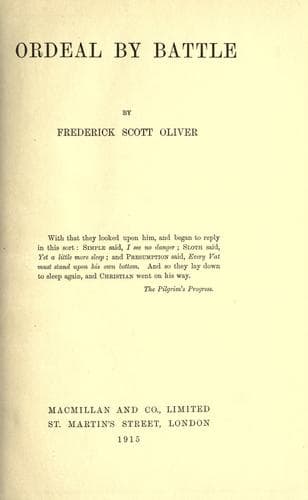
Draft -- Great Britain; Great Britain -- Defenses; World War, 1914-1918
It is essential to put certain notions out of our heads and certain
other notions into them. From the beginning of the war, a large part
of the press--acting, we are entitled to suppose, in patriotic
obedience to the directions of the Press Bureau--has fostered ideas
which do not correspond with the facts. Information has been doled out
and presented in such a way as to destroy all sense of proportion in
the public mind.
It is not an uncommon belief,[4] for example, that we with our
Allies--ever since the first onset, when, {429} being virtuously
unprepared, we were pushed back some little distance--have been doing
much better than the Germans; that for months past our adversaries have
been in a desperate plight--lacking ammunition, on the verge of
bankruptcy and starvation, and thoroughly discouraged.
There is also a tendency to assume--despite Lord Kitchener's grave and
repeated warnings to the contrary--that the war is drawing rapidly to a
conclusion, and that, even if we may have to submit to some
interruption of our usual summer holidays, at any rate we shall eat our
Christmas dinners in an atmosphere of peace and goodwill.
The magnitude of the German victories, both in the East and West,
during the earlier stages of the war, is not realised even now by the
great majority of our fellow-countrymen; while the ruinous consequences
of these victories to our Allies--the occupation of Belgium, of a large
part of northern France, and of Western Poland--is dwelt on far too
lightly. Nor is it understood by one man in a hundred, that up to the
end of last year, British troops were never holding more than thirty
miles, out of that line of nearly five hundred which winds, like a
great snake, from Nieuport to the Swiss frontier. On the contrary, it
is quite commonly believed that we have been doing our fair share of
the fighting--or even more--by land as well as sea.
A misleading emphasis of type and comment, together with a dangerous
selection of items of news, are responsible for these illusions; while
the prevalence of these illusions is largely responsible for many of
our labour difficulties.
Such dreams of inevitable and speedy victory {430} are no doubt very
soothing to indolent and timid minds, but they do not make for a
vigorous and resolute spirit in the nation, upon which, more than upon
anything else, the winning of this war depends.
In some quarters there appears still to linger a ridiculous idea that
we went into this war, out of pure chivalry, to defend Belgium.[5] We
went into it to defend our own existence, and for no other reason. We
made common cause with Allies who were menaced by the same danger as
ourselves; but these, most fortunately, had made their preparations
with greater foresight than we had done. The actual fighting has taken
place, so far, in their territories and not in ours; but the issue of
this war is not one whit less a matter of life-or-death for us, than it
is for them.
Public-domain text, read in full here on John Shaqi.
Reviews
Reviews
No reviews yet
Be the first to share your thoughts on this work.
Elsewhere in the archive
Join the Discussion
Join the discussion
Sign in to leave a comment or review.
Sign InorCreate an account