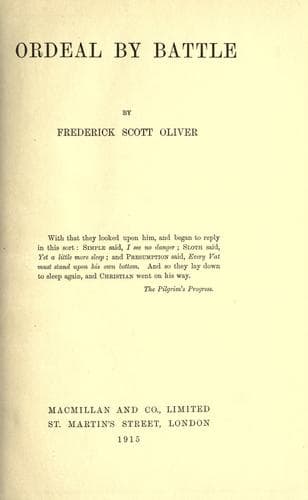
Draft -- Great Britain; Great Britain -- Defenses; World War, 1914-1918
[Sidenote: DEMOCRACY NOT INVINCIBLE]
Quite recently I have seen our present situation described glowingly
and self-complacently as the 'triumph of the voluntary system.' I must
be blind of both eyes, for I can perceive no 'triumph' and no
'voluntary' system. I have seen the territories of our Allies seized,
wasted, and held fast by an undefeated enemy. I have seen our small
army driven back; fighting with as much skill and bravery as ever in
its history; suffering losses unparalleled in its history; holding its
own in the end, but against what overwhelming numbers and by what
sacrifices! The human triumph is apparent enough; but not that of any
system, voluntary or otherwise. Neither in this record of nine months'
'hard and hot fighting' on land, nor in {431} the state of things which
now exists at the end of it all, is there a triumph for anything, or
any one, save for a few thousands of brave men, who were left to hold
fast as best they could against intolerable odds.
Certain contemporary writers appear to claim more for that form of
representative government, which we are in the habit of calling
'democracy,' than it is either safe to count on, or true to assert. In
their eyes democracy seems to possess a superiority in all the higher
virtuous qualities--'freedom,' in particular--and also an inherent
strength which--whatever may be the result of the present war--makes
the final predominance of British institutions only a matter of time.[6]
I do not hold with either of these doctrines. Universal superiority in
virtue and strength is too wide a claim to put forward for any system
of government. And 'freedom' is a very hard thing to define.
It is not merely that the form of constitution, which we call
'democracy,' is obviously not the best fitted for governing an
uncivilised or half-civilised people. There are considerations which
go much deeper than that--considerations of race, religion,
temperament, and tradition. As it has been in the past, so conceivably
it may be again in the future, that a people, which is in the highest
degree civilised and humane, will seek to realise its ideals of freedom
in some other sphere than the control of policy and legislation
according to the electoral verdicts of its {432} citizens. It is even
possible that its national aspirations may regard some other end as a
higher good even than freedom. We cannot speak with certainty as to
the whole human race, but only with regard to ourselves and certain
others, who have been bred in the same traditions.
Public-domain text, read in full here on John Shaqi.
Reviews
Reviews
No reviews yet
Be the first to share your thoughts on this work.
Elsewhere in the archive
Join the Discussion
Join the discussion
Sign in to leave a comment or review.
Sign InorCreate an account