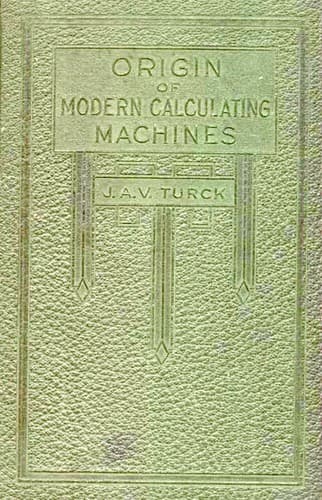
Origin of modern calculating machinesTurck, J. A. V.
History
Origin of modern calculating machines
Turck, J. A. V.
Calculators
Transcriber’s Notes:
Underscores “_” before and after a word or phrase indicate _italics_
in the original text.
Small capitals have been converted to SOLID capitals.
Illustrations have been moved so they do not break up paragraphs.
Typographical and punctuation errors have been silently corrected.
Origin of Modern Calculating
Machines
A chronicle of the evolution of the
principles that form the generic
make-up of the Modern
Calculating Machine
BY
J. A. V. TURCK
Member of The Western Society of Engineers
CHICAGO, 1921
_Published under the auspices of_
The Western Society of Engineers
Copyright, 1921, by
J. A. V. Turck
[Illustration: Stone Age Calculating]
Foreword
There is nothing romantic in figures, and the average man takes little
interest in any subject pertaining to them. As a result of this
antipathy, there is plenty of historic evidence of man’s endeavor to
minimize the hated drudgery of calculation.
While history shows that, from prehistoric man down to the present age,
human ingenuity has turned to mechanical means to overcome the brain
fatigue of arithmetical figuring, it is within quite recent years that
he has really succeeded in devising means more rapid than the human
brain.
Of this modern product little has been written, except in disconnected
articles that have in no case offered a complete understanding as to
who were the great benefactors of mankind that gave to the world the
first concrete production of these modern principles of mechanical
calculation.
The writer, believing that there are many who would be interested to
know the true facts relative to this subject, has given to the public,
in that which follows, a chronicle of the evolution of the principles
disclosed in these modern machines, along with the proofs that form the
foundation for the story in a way that all may understand.
Although the subject has been handled in a way that makes it
unnecessary for the reader to be carried through a jangle of tiresome
mechanical construction, the writer believes that there are many
interested in the detail workings of these machines, and has for that
reason provided an interesting and simple description of the working
of each illustrated machine, which may be read by those who wish, or
skipped over, if the reader desires, without the danger of losing
knowledge of the relation of each of these machines to the Art.
[Illustration]
Chapters
Public-domain text, read in full here on John Shaqi.
Reviews
Reviews
No reviews yet
Be the first to share your thoughts on this work.
Join the Discussion
Join the discussion
Sign in to leave a comment or review.
Sign InorCreate an account