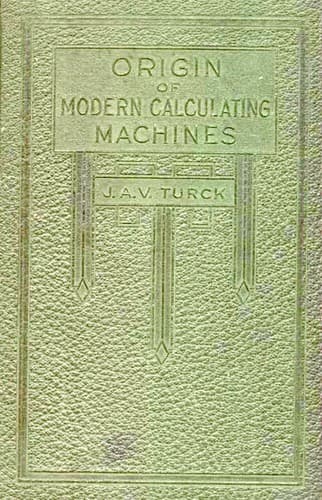
Origin of modern calculating machines — John Shaqi
Origin of modern calculating machinesTurck, J. A. V.
History
Origin of modern calculating machines
Turck, J. A. V.
Calculators
Hill made no provision for overcoming the lightning-speed momentum that
could be given the numeral wheels in his machine through manipulation
of the keys, either from direct key-action or indirectly through the
carry of the tens. Imagine the sudden whirl his numeral wheel would
receive on a quick depression of a key and then consider that he
provided no means for stopping these wheels; it is obvious that a
correct result could not be obtained by the use of such mechanism. Some
idea of what would take place in the Hill machine under manipulation
by an operator may be conceived from the speed attained in the
operation of the keys of the up-to-date modern key-driven machine.
[Sidenote: _High speed of key drive_]
Operators on key-driven machines oftentimes attain a speed of 550 key
strokes a minute in multiplication. Let us presume that any one of
these strokes may be a depression of a nine key. The depression and
return, of course, represents a full stroke, but only half of the
stroke would represent the time in which the wheel acts. Thus the
numeral wheel would be turned nine of its ten points of rotation in an
eleven hundredth (¹/₁₁₀₀) of a minute. That means only one-ninth of
the time given to half of the key-stroke, or a ninety-nine hundredth
(¹/₉₉₀₀) of a minute; a one hundred and sixty-fifth (¹/₁₆₅) part of a
second for a carry to be effected.
[Sidenote: _Camera slow compared with carry of the tens_]
If you have ever watched a camera-shutter work on a twenty-fifth of
a second exposure, which is the average time for a snap-shot with an
ordinary camera, it will be interesting to know that these controlling
devices of a key-driven machine must act in one-fifth the time in which
the shutter allows the daylight to pass through the lens of the camera.
Think of it; a machine built with the idea of offering the possibility
of such key manipulation and supplying nothing to overcome the
tremendous momentum set up in the numeral wheels and their driving
mechanism, unless perchance Hill thought the operator of his machine
could, mentally, control the wheels against over-rotation.
[Illustration]
[Illustration: Chapin Patent Drawings]
Lack of a proper descriptive term used to refer to an object, machine,
etc., oftentimes leads to the use of an erroneous term. To call the
Hill invention an adding machine is erroneous since it would not add
correctly. It is as great an error as it would be to refer to the
Langley aeroplane as a flying machine.
[Sidenote: _Hill machine merely adding mechanism, incomplete as
operative machine_]
Public-domain text, read in full here on John Shaqi.
Reviews
Reviews
No reviews yet
Be the first to share your thoughts on this work.
Join the Discussion
Join the discussion
Sign in to leave a comment or review.
Sign InorCreate an account