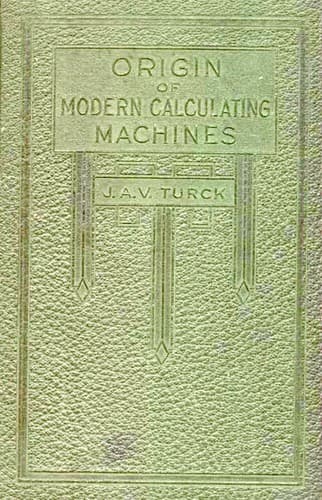
Origin of modern calculating machines — John Shaqi
Origin of modern calculating machinesTurck, J. A. V.
History
Origin of modern calculating machines
Turck, J. A. V.
Calculators
While the discussion of the Art from a scientific standpoint brings
together in after years what has been accomplished by different
inventors, it is doubtful whether any of these early inventors had
other knowledge than what may possibly have been obtained from seeing
one of the foreign-made crank-driven machines. All inventors work with
an idea obtained from some source, but on the whole few copy inventions
of others. When an Art is fully established, however, and machines
representing the Art are to be found on the market and the principal
features of such machines are portrayed in a later patent, it may
rightly be called a copy. To assume, however, that a novice has taken
the trouble to delve into the archives of the patent office and study
the scattered theoretical elements of the Art and supply a new element
to make a combination that is needed to produce a practical key-driven
calculator, is not a probable assumption. But allowing such assumption
were possible, it is evident that from anything that the Art disclosed
prior to 1887 it was not possible to solve the concrete production of a
key-driven calculator.
[Sidenote: _A conception which led to the final solution_]
In 1884, a young machinist, while running a planer, conceived an idea
from watching its ratchet feed motion, which was indirectly responsible
for the final solution of the multiple-order key-driven calculating
machine. The motion, which was like that to be found on all planing
machines, could be adjusted to ratchet one, two, three, four or more
teeth for a fine or coarse feed.
While there is nothing in such a motion that would in any way solve the
problem of the modern calculator, it was enough to excite the ambitions
of the man who did finally solve it. It is stated that the young man,
after months of thought, made a wooden model, which he finished early
in 1885. This model is extant, and is illustrated on the opposite page.
The inventor was Dorr E. Felt, who is well known in the calculating
machine Art as the manufacturer of the “Comptometer,” and in public
life as a keen student of economic and scientific subjects. The wooden
model, as will be noted, was crude, but it held the nucleus of the
machine to come.
[Illustration: “Macaroni Box” Model]
[Illustration: Dorr E. Felt]
Mr. Felt has given some interesting facts regarding his experience in
making the wooden model.
[Sidenote: _Evolution of an invention_]
He says: “Watching the planer-feed set me to scheming on ideas for
a machine to simplify the hard grind of the bookkeeper in his day’s
calculation of accounts.
Public-domain text, read in full here on John Shaqi.
Reviews
Reviews
No reviews yet
Be the first to share your thoughts on this work.
Join the Discussion
Join the discussion
Sign in to leave a comment or review.
Sign InorCreate an account