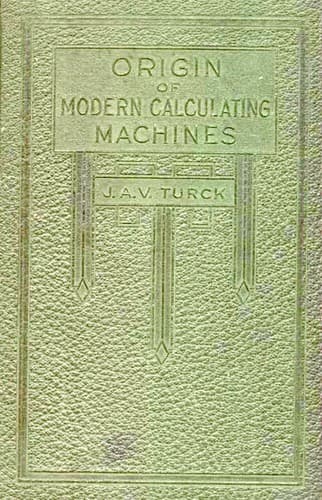
Origin of modern calculating machinesTurck, J. A. V.
History
Origin of modern calculating machines
Turck, J. A. V.
Calculators
The Art of recording the addition of columns of figures is old in
principle, but not in practice. Many attempts to make a machine that
would record legibly under all conditions failed. These attempts have
been pointed out from time to time as the first invention of the
recording-adding machine, especially by those desirous of claiming the
laurels.
[Sidenote: _First attempt to record arithmetical computation_]
The first attempt at arithmetical recording for which a patent was
issued, was made by E. D. Barbour in 1872 (see illustration on opposite
page).
E. D. Barbour has also the honor of being the first inventor to apply
Napier’s principle to mechanism intended to automatically register
the result of multiplying a number having several ordinal places by a
single digit without mentally adding together the overlapping figures
resulting from direct multiplication. He patented this machine in 1872
just prior to the issue of his arithmetical recorder patent. (See page
181.)
THE BARBOUR MACHINE
The printing device disclosed in connection with the Barbour machine
for recording calculations was of the most simple nature, allowing only
for the printing of totals and sub-totals.
Its manipulation consisted of placing a piece of paper under a hinged
platen and depressing the platen by hand in the same manner that a time
stamp is used. The ink had to be daubed on the type by a hand operation
to make legible the impressions of the type.
[Sidenote: _Description of Barbour machine_]
The patent drawings of the Barbour machine are so fragmentary that it
is almost impossible to draw any conclusion as to its functions without
reading the specifications.
Fig. 1 represents the base of the machine, while Fig. 4 shows a
carriage which, when in place, is superimposed above the base as
illustrated in Figs. 3 and 5.
The operation of the machine is performed by first pulling out the
slides B (shown in Fig. 1), which set the digital degrees of actuation
of each order; and, second, by operating the hand-lever K, from its
normal position at 0 to 1, if it is desired to add, or to any of
the other numbers in accordance to the value of the multiplier if
multiplication is desired.
The movement of the handle K, from one figure to the other, gives a
reciprocation to the carriage, so that for each figure a reciprocation
will take place.
Each of the slides B, has a series of nine gear racks; each rack has a
number of teeth ranging progressively from 1 tooth for the first gear
rack to 9 teeth for the last rack, thus the pulling out of the slides B
will present one of the gear racks in line to act upon the accumulator
mechanism of the carriage as the carriage is moved back and forth over
it.
The accumulator mechanism consists of the register wheels M¹ and M²
and the type wheels M³ and M⁴ mounted on a common arbor and a carry
transfer device between the wheels of each order.
Public-domain text, read in full here on John Shaqi.
Reviews
Reviews
No reviews yet
Be the first to share your thoughts on this work.
Join the Discussion
Join the discussion
Sign in to leave a comment or review.
Sign InorCreate an account