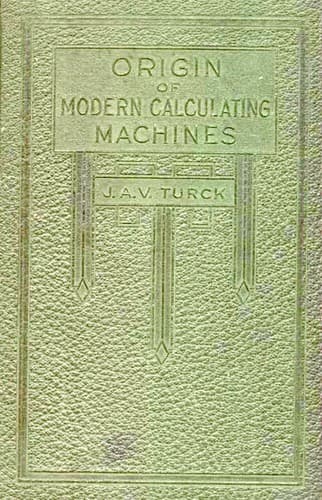
Origin of modern calculating machinesTurck, J. A. V.
History
Origin of modern calculating machines
Turck, J. A. V.
Calculators
[Illustration: Baldwin Machine]
The figures showing below serve to register multiples of addition and
subtraction which would read as the multiplier in multiplications
or the quotient in division. These wheels are the type wheels N, in
the patent drawings, which serve the purpose of recording the named
functions of calculation.
The means by which the type wheels of the upper row are turned through
the varying degrees of rotation they receive to register the results
of calculation, consists of a crank-driven, revolvable drum, marked E,
which is provided with several denominational series of projectable
gear teeth h, which may be made to protrude through the drum by
operation of the digital setting-knobs g, situated on the outside of
the drum.
These knobs, as shown in the patent drawings, are fast to radial arms,
each of which serves as one of three spokes of a half-wheel device,
operating inside the drum and pivoted on the inner hub of the drum.
These half wheels marked F, in the drawings, by means of their cam
faces h¹, serve to force the gear teeth out through the face of the
drum, or let them recede under the action of their springs as the knobs
g, are operated forward and back in the slots x, of the drum provided
for the purpose.
As will be noted from the photographic reproduction of the machine,
these slots are notched to allow the arms extending through them to
be locked in nine different radial positions, and that each of these
positions are marked progressively from 0 to 9.
This arrangement allows the operator to set up numbers in the different
orders by springing the setting-knobs g to the left and pulling them
forward to the number desired, where it will become locked in the notch
when released. This action will have forced out as many gear teeth
in each order as have been set up by the knobs g in their respective
orders.
The lateral positions of the projectable gear teeth correspond to
the spacing of the type-wheels, and an intermediate gear G, meshing
with each type, or register wheel, is loosely mounted on the shaft H,
interposed between the said wheels and the actuating drum E, so that
when the drum is revolved by the crank provided for that purpose, the
gear teeth protruding from the drum will engage the intermediate gears
G, and turn them and their type or register wheels as many of their ten
points of rotation as have been set up in their respective orders of
the setting devices of the drum.
Revolving the drum in one direction adds, while revolving it in the
opposite direction subtracts, and repeated revolutions in either
direction give respectively the multiple forms of addition or
subtraction which result in either multiplication or division, as the
case may be.
The actuating drum E, is provided with means by which it may be shifted
to the left to furnish means for multiplying by more than one factor
and to simplify the process of division.
Public-domain text, read in full here on John Shaqi.
Reviews
Reviews
No reviews yet
Be the first to share your thoughts on this work.
Join the Discussion
Join the discussion
Sign in to leave a comment or review.
Sign InorCreate an account