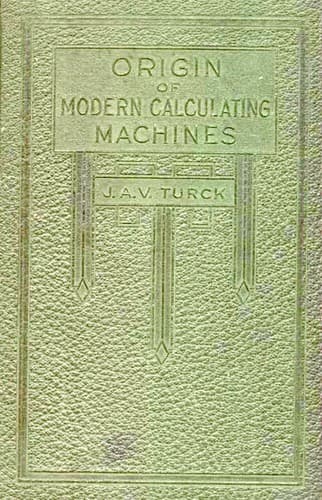
Origin of modern calculating machinesTurck, J. A. V.
History
Origin of modern calculating machines
Turck, J. A. V.
Calculators
An outgrowth of the recording-machine Art is represented in a new type
of recording machine especially adapted to bookkeeping and the making
out of invoices or reports where typewriting combined with arithmetical
recording is necessary. This class of work demands a combination of the
typewriter with adding and multiplying mechanism, having a capacity for
printing the totals of either addition or multiplication.
[Sidenote: _Early Combinations_]
Several attempts have been made to combine the typewriter and
adding-recorder; and there have been combinations of multiplying and
recording. Another combination that has been used to some extent for
bookkeeping and billing is an adding attachment for typewriters, but
all these combinations were lacking in one feature or another of what
may be called a real bookkeeping machine and billing machine.
The combination of the typewriter and multiple-order keyboard
recording-adders was too cumbersome, and the means employed for
multiplication on such machines required too many manipulative motions
from the operator. In simple cases of multiplication as high as fifty
manipulative motions would be required to perform an example on such a
machine.
[Illustration: “Moon-Hopkins” Billing and Bookkeeping Machine]
The combination of multiplying mechanism, either direct or by repeated
stroke, with the multiple keyboard has been made, but without the
typewriting feature they do not serve as a real bookkeeping and billing
machine.
The combination of the typewriter and the adding attachment lacks
automatic means to print totals. The operator must read the totals and
print them with the typewriter. Multiplication on such a combination
is, of course, out of the question.
[Sidenote: _First Practical Combination_]
The culmination of the quest for a practical bookkeeping machine is
a peculiar one, as it was dependent upon the ten-key recorder, which
has never become as popular as the multiple-order keyboard on account
of its limited capacity. The simplicity of its keyboard, however,
lent to its combination with the typewriter, and the application of
direct multiplication removed a large per cent of the limitation
which formerly stood as an objection to this class of machine when
multiplication becomes necessary.
For the combination, which finally produced the desired result, we
must thank Mr. Hubert Hopkins, who is not only the patentee of such
a combination, but also the inventor of the first practical ten-key
recording-adder which has become commercially known as the “Dalton”
machine.
[Sidenote: _Moon-Hopkins Billing Machine_]
His bookkeeping machine is commercially known as the “Moon-Hopkins
Billing Machine.” See illustration on opposite page.
The term “Bookkeeping Machine” has been misused by applying it to
machines which only perform some of the functions of bookkeeping.
Public-domain text, read in full here on John Shaqi.
Reviews
Reviews
No reviews yet
Be the first to share your thoughts on this work.
Elsewhere in the archive
Join the Discussion
Join the discussion
Sign in to leave a comment or review.
Sign InorCreate an account