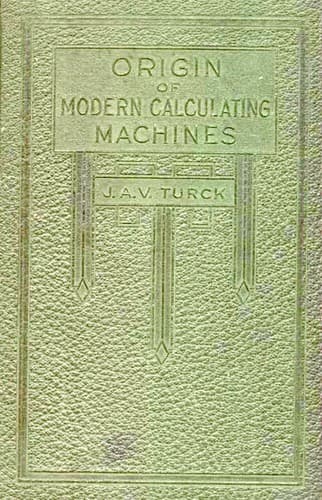
Origin of modern calculating machinesTurck, J. A. V.
History
Origin of modern calculating machines
Turck, J. A. V.
Calculators
Another means than that invented by Felt to signal the operator when a
predetermined number of items have been recorded, consists of a bell,
which rings to notify the operator to that effect. This signal was
the invention of J. G. Vincent, and is shown in patent No. 968,005 of
August 23, 1910, and was applied for December 3, 1909, as an attachment
to the carriage of the Burroughs machine.
[Sidenote: _Subtraction by reverse action_]
Although subtraction has always been accomplished on this type of
machine as a means of correcting an error, it was always accomplished
on the Burroughs recorder by the use of what is generally known as
the complimental method, which, without special provision, is rather
objectionable. On the 22d of April, 1910, Wm. E. Swalm applied for a
patent which was issued June 4, which shows means connected with the
Burroughs machine that allowed subtraction to be made by the direct
method by setting the keys the same as for addition. The patent number
is 1,028,149.
[Sidenote: _Selective split for keyboard_]
A further improvement on the split keyboard feature is shown in a
patent issued to Fred A. Niemann in which is shown an individually
selective cipher cut-out that splits the keyboard into any combination
at the will of the operator. The said patent is No. 1,309,692,
applied for October 7, 1912, and issued July 15, 1919, and shows the
improvement in combination with the Felt “Comptograph.”
[Sidenote: _Rapid paper insert and ejector_]
In some classes of listing or tabulating it is an advantage to enter
the paper and eject it with a rapidity that will facilitate the
handling of a large number of sheets, such for instance as the usual
bank statements. In patent No. 1,208,375 F. C. Rinche shows how he
accomplished this feature on the Burroughs recorder. The patent was
applied for July 21, 1913, and issued December 12, 1916.
Of the named improvements, of course, all are designed to fit the
requirements of the machines they are shown as a part of in the
drawings of the patent. They are also claimed as adaptable to other
machines of the type, but some are so specific to the machine they
form an improvement on that they are not adaptable to other makes.
Again some give results on the machine they form a part of that was
accomplished in a different way in another make.
Most of the improvements named, however, are of such a nature that the
broad feature disclosed is adaptable to all makes if mechanism should
be specially designed to suit such machines that will function to give
the result.
[Illustration]
The Bookkeeping and Billing Machine
Public-domain text, read in full here on John Shaqi.
Reviews
Reviews
No reviews yet
Be the first to share your thoughts on this work.
Elsewhere in the archive
Join the Discussion
Join the discussion
Sign in to leave a comment or review.
Sign InorCreate an account