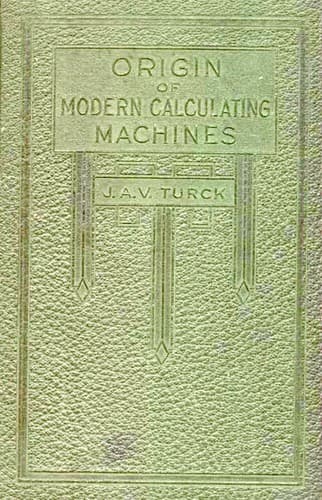
Origin of modern calculating machinesTurck, J. A. V.
History
Origin of modern calculating machines
Turck, J. A. V.
Calculators
Hopkins constructed his multiplying mechanism on the Bollee scheme of
using stepped controlling plates for his reciprocating racks to give
the multiples of the digits, but the ingenious method of application
shown in the Hopkins patent drawings illustrates well the American
foresight of simplicity of manufacture.
During the past ten years there have been a large number of patents
applied for on mechanism containing the same general scheme as that
of Bollee and Steiger, but up to the present writing no machines with
direct multiplying mechanism have been commercialized except “The
Millionaire,” which is non-recording, and “Moon-Hopkins Bookkeeping
Machine.”
A Closing Word
As previously stated, it is impossible to describe or illustrate
the thousands of inventions that have been patented in the Art of
accounting machines, and some of the inventors may feel that the writer
has shown partiality. The subject of this book, however, has to do only
with the Art as it stands commercialized and those who are responsible
for its existence.
In the arguments to prove validity of contributions of vital importance
to the Art, many other patented machines have been used which really
have no bearing on the Art. But the writer was obliged to show their
defects, otherwise the misconception derived from articles written by
authors incompetent to judge would leave the public in error as to the
real truth relative to the Art of the modern accounting machines.
That all inventors deserve credit, even in the face of failure, is
without question. The hours, days, months, and sometimes years, given
up to the working out of any machine, intended to benefit mankind,
whether the result brings a return or not,--whether the invention
holds value, or no,--leaves a record that the world may benefit by, in
pointing out the errors or productive results.
If it were not for the ambitions and untiring efforts of men of this
type, who give heart and soul to the working out of intricate problems,
the world would not be as far advanced as it is today.
The writer has kept in close touch with the Art of calculating machines
since 1893, and made exhaustive research of it prior to that period.
There have been thousands of patents issued on machines of the class
herein set forth, but outside of the features reviewed there have been
no broadly new ones of practical importance that have as yet proved to
be of great value to the public. What is in the making, and what may
be developed later, is open to conjecture. It is a safe conjecture,
however, that in the present high state of the Art it will tax the
wits of high-class engineers to offer any substantial and broadly new
feature which will be heralded as a noticeable step in the Art. And
that, as in the past, thousands of mistakes, and impractical as well as
inoperative machines will be made and patented, to one that will hold
real value.
[Illustration]
Index to Subjects
Public-domain text, read in full here on John Shaqi.
Reviews
Reviews
No reviews yet
Be the first to share your thoughts on this work.
Elsewhere in the archive
Join the Discussion
Join the discussion
Sign in to leave a comment or review.
Sign InorCreate an account