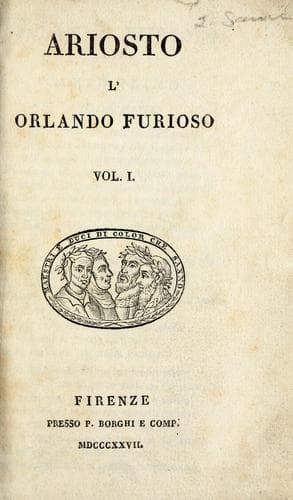
Epic poetry, Italian -- Translations into English; Knights and knighthood -- Poetry; Roland (Legendary character) -- Romances
XII
"After some days, of fair Geneura he
A suitor showed himself; I cannot say
If this began before he sighed for me,
Or, after, of this love he made assay:
But judge, alas! with what supremacy
He ruled my heart, how absolute his sway!
Since this he owned, and thought no shame to move
Me to assist him in his second love.
XIII
"Unlike what he bore me, he said, indeed,
That was not true which he for her displayed;
But so pretending love, he hoped to speed,
And celebrate due spousals with the maid.
He with her royal sire might well succeed,
Were she consenting to the boon he prayed;
For after our good king, for wealth and birth
In all the realm, was none of equal worth.
XIV
"Me he persuades, if through my ministry
He the king's son-in-law elected were,
For I must know he next the king would be
Advanced as high, as subject could repair,
The merit should be mine, and ever he
So great a benefit in mind would bear;
And he would cherish me above his bride,
And more than every other dame beside.
XV
"I, who to please him was entirely bent,
Who never could or would gainsay his will,
Upon those days alone enjoy content,
When I find means his wishes to fulfil:
And snatch at all occasions which present
A mode, his praise and merits to instil:
And for my lover with all labour strain,
And industry, Geneura's love to gain.
XVI
"With all my heart, in furtherance of his suit,
I wrought what could be done, God truly knows;
But with Geneura this produced no friut,
Nor her to grace my duke could I dispose.
For that another love had taken root
In her, whose every fond affection flows
Towards a gentle knight of courteous lore,
Who sought our Scotland from a distant shore:
XVII
"And with a brother, then right young, to stay
In our king's court, came out of Italy:
And there of knightly arms made such assay,
Was none in Britain more approved than he;
Prized by the king, who (no ignoble pay),
Rewarding him like his nobility,
Bestowed upon the youth, with liberal hand,
Burghs, baronies, and castles, woods and land.
XVIII
"Dear to the monarch, to the daughter still
This lord was dearer, Ariodantes hight.
Her with affection might his valour fill;
But knowledge of his love brought more delight.
Nor old Vesuvius, nor Sicilia's hill,
Nor Troy-town, ever, with a blaze so bright,
Flamed, as with all his heart, the damsel learned,
For love of her young Ariodantes burned.
XIX
"The passion which she bore the lord, preferred
And loved with perfect truth and all her heart,
Was the occassion I was still unheard;
Nor hopeful answer would she e'er impart:
And still the more my lover's suit I stirred,
And to obtain his guerdon strove with art,
Him she would censure still, and ever more
Was strengthened in the hate she nursed before.
Public-domain text, read in full here on John Shaqi.
Reviews
Reviews
No reviews yet
Be the first to share your thoughts on this work.
Join the Discussion
Join the discussion
Sign in to leave a comment or review.
Sign InorCreate an account