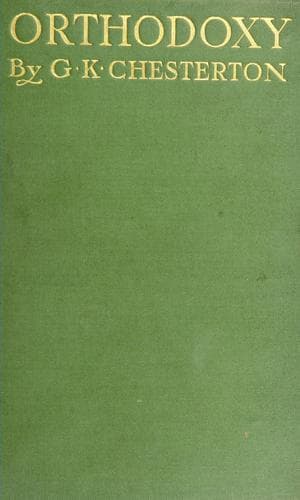
Apologetics; Chesterton, G. K. (Gilbert Keith), 1874-1936; Christianity -- Essence, genius, nature
It may be added that the same blank and bankruptcy can be observed in
all fierce and terrible types of literature, especially in satire.
Satire may be mad and anarchic, but it presupposes an admitted
superiority in certain things over others; it presupposes a standard.
When little boys in the street laugh at the fatness of some
distinguished journalist, they are unconsciously assuming a standard of
Greek sculpture. They are appealing to the marble Apollo. And the
curious disappearance of satire from our literature is an instance of
the fierce things fading for want of any principle to be fierce about.
Nietzsche had some natural talent for sarcasm: he could sneer, though he
could not laugh; but there is always something bodiless and without
weight in his satire, simply because it has not any mass of common
morality behind it. He is himself more preposterous than anything he
denounces. But, indeed, Nietzsche will stand very well as the type of
the whole of this failure of abstract violence. The softening of the
brain which ultimately overtook him was not a physical accident. If
Nietzsche had not ended in imbecility, Nietzscheism would end in
imbecility. Thinking in isolation and with pride ends in being an idiot.
Every man who will not have softening of the heart must at last have
softening of the brain.
This last attempt to evade intellectualism ends in intellectualism, and
therefore in death. The sortie has failed. The wild worship of
lawlessness and the materialist worship of law end in the same void.
Nietzsche scales staggering mountains, but he turns up ultimately in
Tibet. He sits down beside Tolstoy in the land of nothing and Nirvana.
They are both helpless--one because he must not grasp anything, and the
other because he must not let go of anything. The Tolstoyan's will is
frozen by a Buddhist instinct that all special actions are evil. But the
Nietzscheite's will is quite equally frozen by his view that all special
actions are good; for if all special actions are good, none of them are
special. They stand at the cross-roads, and one hates all the roads and
the other likes all the roads. The result is--well, some things are not
hard to calculate. They stand at the cross-roads.
Public-domain text, read in full here on John Shaqi.
Reviews
Reviews
No reviews yet
Be the first to share your thoughts on this work.
Join the Discussion
Join the discussion
Sign in to leave a comment or review.
Sign InorCreate an account