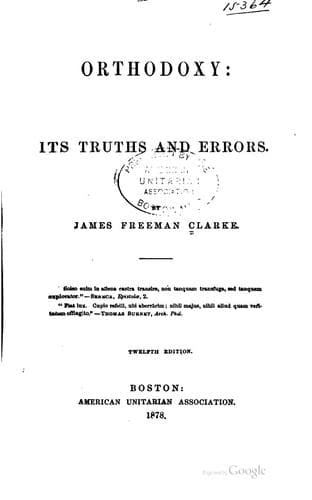
Orthodoxy: Its Truths And ErrorsClarke, James Freeman
Religion
Orthodoxy: Its Truths And Errors
Clarke, James Freeman
Unitarianism
Paul replies that “sin is not _imputed_ without law;” that is, as I think
evident, it is not regarded as _guilt_. A man who sins ignorantly is not
_guilty_; but he _suffers_ the consequences of his sin, which are
depravity of his nature, or moral death. “Sin is not imputed,” says Paul;
“but death reigns.” Those who do not sin “after the similitude of Adam’s
transgression,”—that is, who do not violate a positive
command,—nevertheless are depraved morally, and are dead spiritually. The
Hottentots and Fejee Islanders violate no positive law given them by God,
and consequently are not guilty of that; but because they violate (even
ignorantly) the laws of their moral nature, they are depraved morally.
We see, then, that Paul distinctly recognizes the distinction made above
between _sin as guilt_ and _sin as depravity_.
He distinguishes between sin as sinfulness, or unconscious transgression
(ἡ ἁμαρτία), and sin as conscious transgression of a known command
(παράβασις).
The consequence of the first is death, or moral and spiritual depravity;
the consequence of the second is condemnation, or a sense of guilt.
Sinfulness, bringing with it depravity (the general demoralization of
human nature), began with Adam. All became involved in sinfulness, and
consequently all partook of the depravity which belongs to it as its
wages.
It should, however, be observed that it is not the purpose of Paul to
teach anything about Adam. His intention is to teach something about
Christ. He refers to Adam’s case as something they all are acquainted
with; he compares Christ’s case with it both by contrast and resemblance.
But his object is not to instruct us about Adam, but about Christ. He uses
Adam as an example to enforce his doctrine about Christ. Through Christ,
goodness and happiness were to come into the world. He illustrated this
fact, and made it appear probable, by the fact which they already
knew—that through Adam sin and death had entered the world. If it seemed
strange, in an age in which men were so disunited, that one man should be
the medium of communicating goodness to the whole human race, they might
remember that Adam also had been the medium of introducing sin to the
whole human race. If the Jews wondered that Christ should bring salvation
to those who were not under the law, they might remember that Adam had
brought death to those not under the law, and who did not sin as he did.
If they doubted how Christ’s goodness could help to make men righteous,
they might remember that in some way Adam’s transgression had helped to
make men sinners. Yet, after all, the main fact which he states is in the
twelfth verse, chapter five—“that by one man sin _entered into_ the world,
and death by sin.” This amounts to saying that sin _began_ with Adam. Then
he adds, in the same verse, “that death has passed upon all men, _because
all have sinned_.” He therefore distinctly declares that every man is
punished for his own sin, and not for the sin of Adam.
Public-domain text, read in full here on John Shaqi.
Reviews
Reviews
No reviews yet
Be the first to share your thoughts on this work.
Elsewhere in the archive
Join the Discussion
Join the discussion
Sign in to leave a comment or review.
Sign InorCreate an account