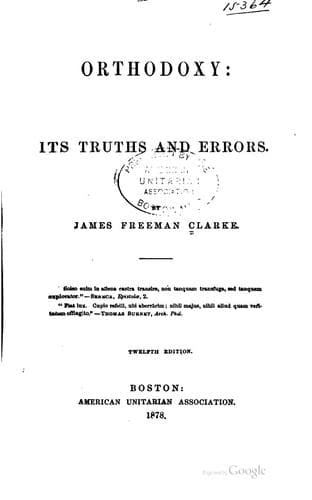
Orthodoxy: Its Truths And ErrorsClarke, James Freeman
Religion
Orthodoxy: Its Truths And Errors
Clarke, James Freeman
Unitarianism
In the other passage (1 Cor. 15:22), Paul says, “As in Adam all die, even
so, in Christ, shall all be made alive.” He does not say here, either that
“all sinned in Adam,” or that “all fell in Adam,” or that “all died in
Adam.” It is the present tense, “all die in Adam.”
What he means by this, he explains himself afterwards. He tells us that as
“souls” descended from Adam, we are liable to death; as spirits quickened
by Christ, we are filled with spiritual and immortal life.
In the forty-fourth verse he gives the explanation. The body “is _sown_ a
natural body” (σῶμα ψυχικὸν)—literally a soul-body, a body vitalized by
the soul. “It is raised a spiritual body”—literally spirit-body (σῶμα
πνευματικὸν), a body vitalized by the spirit. “There is a soul-body, and
there in a spirit-body.” “And so it is written, The first man, Adam, was
made a living soul” (which is a quotation from Genesis 2:7—“and man became
a living soul”), “but the last Adam,” says Paul (meaning Christ), “became
a life-making spirit.” But, continues Paul, the soul-man (psychical man)
comes first; the spiritual-man afterwards, according to a regular order.
“The first man is of the earth, earthy; the second is the Lord from
heaven.” And then he adds,—and this is the key to the whole passage,—“_As
we have borne the __ image of the earthy_, we shall also bear the image of
_the heavenly_.” The doctrine, then, is plainly this: that we have two
natures—a soul-nature, which we derive from Adam, and share with all
mankind, which nature is liable to weakness, sin, and death; and a
spirit-nature, which we derive from God, which Christ comes to quicken and
vitalize, and the life of which constitutes our true immortality.
The apostle Paul, therefore, does not by any means teach Calvinism. The
Catechism says that “our first parents being the root of all mankind, the
guilt of their sin was imputed to all their posterity.” But Paul says, “So
death passed upon all men, because all have sinned.” The Catechism says
that “this same death in sin, and corrupted nature, being conveyed to
their posterity, makes us utterly indisposed and opposite to all good,”
and that “from this original corruption do proceed all actual
transgressions.”
But if this is so, there has been no such thing in the world as guilt
since Adam fell. If all actual transgressions proceed from original
corruption, and original corruption comes from the first transgression of
Adam, it logically follows that there has been but one sin committed in
the world since it was made, namely, the sin of Adam. All other sins have
been pure misfortunes; his alone was guilt. His transgression alone came
from a free choice; all others have come from an involuntary necessity of
nature.
Public-domain text, read in full here on John Shaqi.
Reviews
Reviews
No reviews yet
Be the first to share your thoughts on this work.
Elsewhere in the archive
Join the Discussion
Join the discussion
Sign in to leave a comment or review.
Sign InorCreate an account