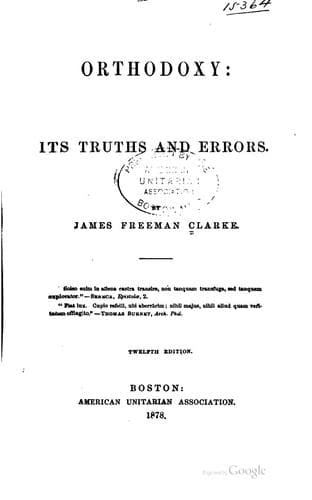
Orthodoxy: Its Truths And ErrorsClarke, James Freeman
Religion
Orthodoxy: Its Truths And Errors
Clarke, James Freeman
Unitarianism
Nothing can be more certain from reason and Scripture than this—that
transgressions which come from a corrupt nature are just so far done in
us, and not done by us. This the apostle distinctly affirms when he says
(7:17), “Now, then, it is no more I that do it, but sin that dwelleth in
me.” No man is responsible for disease, when he has not brought that
disease on himself, but inherited it from his ancestors. The disease may
make him very odious, very disagreeable, but cannot make him blamable.
Therefore, when Calvin says that hereditary depravity “renders us
obnoxious to the divine wrath,” he utters an absurdity. This confusion of
ideas runs through all Orthodox statements on the subject, and the only
cure is, that we should learn how to make this distinction between natural
evil and moral evil, or the evil which proceeds from a corrupt nature and
the evil which comes from a free will.
If we were to sum up the doctrine of the apostle Paul on this subject, it
would be thus:—
1. The first man, Adam, consisted, as we all consist, of nature and will.
His nature consisted of innocent tendencies and appetites. None were
excessive; all were well balanced. His nature inclined him no more to evil
than to good, but each faculty was in proper poise. The first sin,
therefore, could not have been a gross one; it was a simple transgression;
but its effect was to introduce what the apostle calls _death_; that is, a
diseased or corrupt nature. The process is this: With the first conscious
and free transgression there arises a sense of guilt. This sense of guilt
leads the soul away from God. Adam and Eve hide in the garden. Every act
of sin tends to create a habit, and so destroys the moral equipoise. There
hence arises a tendency _towards_ evil, and _from_ good; and this is
called death, because it takes us away from God, who is the source of
life.
2. A tendency towards evil is thus introduced into the world by the
transgression of the first man. His descendants are now born with a nature
which is not in equipoise, but which leans more towards evil than towards
good. Their will remains free as before; but they cannot perform the same
amount of good as before. These corrupt tendencies tempt to greater sin
than the pure tendencies did, and, whenever yielded to, bring a greater
amount of moral evil into the race.
Public-domain text, read in full here on John Shaqi.
Reviews
Reviews
No reviews yet
Be the first to share your thoughts on this work.
Elsewhere in the archive
Join the Discussion
Join the discussion
Sign in to leave a comment or review.
Sign InorCreate an account