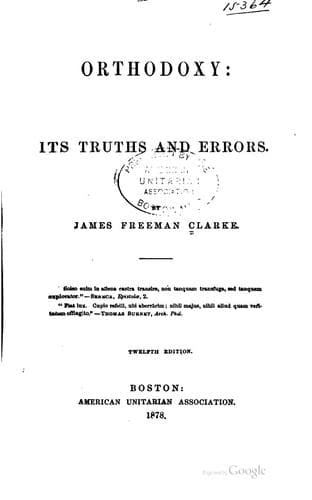
Orthodoxy: Its Truths And ErrorsClarke, James Freeman
Religion
Orthodoxy: Its Truths And Errors
Clarke, James Freeman
Unitarianism
Let us look, then, at what Orthodoxy says of the _extent_ of human
depravity. In all the principal creeds, this is stated to be unlimited.
Man’s sin is total and entire. There is nothing good in him. The
Westminster Confession and the Confession of the New England
Congregational churches describe him as “dead in sin, and wholly defiled
in all the faculties and parts of soul and body.” Other creeds use similar
language.
In considering this theory, we are struck at first by the circumstance,
that the Bible gives it very little support. The Bible continually speaks
of man as a sinner; but there are very few texts which can, without
straining, be made to _seem_ to teach that he is totally depraved. Let us
examine a few of them.
§ 8. Proof Texts.
1. A text often cited is Genesis 6:5,—the reason given for destroying the
human race, in the time of Noah, by the deluge: “And God saw that the
wickedness of man was great in the earth, and that every imagination of
the thoughts of his heart was only evil continually.” But this seems to be
a description of the state of the world at that particular time, not of
its character in all ages. It is not a description of man’s natural
condition, but of an extremely degenerate condition. If the state of the
world here described was its natural state, it would rather be a reason
for not having created the race at first; or, if it was a reason for
destroying it, it would, at best, seem to be as strong a one against
creating it again. If a man plants a tree in his garden, whose nature he
knows is to produce a certain kind of fruit, it would seem hardly a good
reason for cutting it down, that it produced that kind of fruit: certainly
it would not be a good reason for cutting it down, and planting another of
precisely the same kind in its place. The reason why the race of men was
destroyed was, that it had _degenerated_. But there were some good even
then; for in the ninth verse we are told that “Noah was a just man, and
perfect in his generation, and walked with God.”
2. There is another passage, in the fourteenth Psalm which is quoted by
Paul in Rom. 3: “There is none righteous; no, not one: there is none that
understandeth, none that seeketh after God. They have all gone out of the
way, they are together become unprofitable: there is none that doeth good;
no, not one. There is no fear of God before their eyes.”
This passage is relied on to prove total depravity. But we may reply,
that—
This also is a degenerate condition, not a natural one. It was a condition
into which men had fallen, not one in which they were born. “They have all
_gone_ out of the way; they are together _become_ unprofitable.” It does
not, therefore, apply to men _universally_, but to men in those particular
times.
Public-domain text, read in full here on John Shaqi.
Reviews
Reviews
No reviews yet
Be the first to share your thoughts on this work.
Elsewhere in the archive
Join the Discussion
Join the discussion
Sign in to leave a comment or review.
Sign InorCreate an account