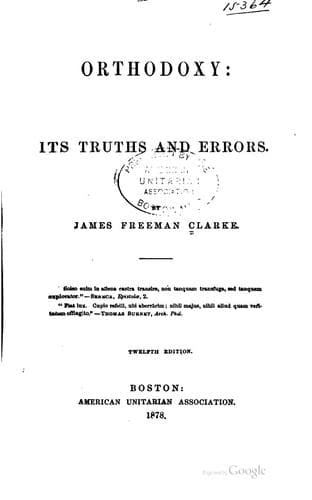
Orthodoxy: Its Truths And ErrorsClarke, James Freeman
Religion
Orthodoxy: Its Truths And Errors
Clarke, James Freeman
Unitarianism
It was not true of _all_, even at that particular time. It was not true of
David himself, that he did not seek after God, or have the fear of God
before his eyes; or else other passages in the same book are not true, in
which he says the contrary. “O God! early will I seek thee: my soul
thirsteth for thee; my flesh longeth for thee.” He also frequently speaks
of and to those who fear the Lord, and says, “I am a companion to all
those that fear thee.”
The “all” is not to be taken strictly. It means people generally at that
time. Just so it is said, “There went out to him Jerusalem and _all_
Judea, and _all_ the region round about Jordan;” which does not imply that
_no one_ staid at home.
“But,” it may be said, “does not Paul teach that this is to be taken
universally, when he quotes it, and adds, ‘Now we know that what the law
saith, it saith to those under the law, that every mouth be stopped, and
all the world guilty before God’ ”? We think he means to say, that, as
this is said to Jews, it proves that _Jews_, as well as Gentiles, are very
guilty. He is addressing the Jews, who boasted of their knowledge of the
law. Chap. 2: “Behold, thou art called a Jew,” &c.
3. Jer. 17:9. “The heart is deceitful above all things, and desperately
wicked.”
If we suppose that we are to take this as an unlimited expression, and not
merely a strong declaration of the wickedness of the Jews, it still does
not prove total depravity of the nature, but merely that of the
affections, or “the heart.” Man’s nature has other things besides desire:
it has conscience, reason, and will; and it does not follow that these are
also depraved.
4. Rom. 8:7. “The carnal mind is enmity against God.”
This does not intend that the mind of man, in its _natural_ state, is
enmity, but in its _carnal_ state; that is, when subject to fleshly
desires. Nearly the same phrase is used in the verse before, and is
translated, “To be carnally minded is death.”
5. There is one famous passage, however, which seems to say that God is
angry with us on account of our nature. This is a passage very much
quoted, and we hear it so often that it seems as if the Bible was full of
such texts. It is in Eph. 2:3. “We were by nature _children of wrath_,
even as others.” This is quoted to prove that God is angry with men for
their natures, and hates them for being born evil—just as we may hate a
snake, a scorpion, or spider, for its nature. But, as it happens, the very
next verses show that this is impossible, unless God can be hating one of
his creatures and loving it at the very same moment.
Public-domain text, read in full here on John Shaqi.
Reviews
Reviews
No reviews yet
Be the first to share your thoughts on this work.
Elsewhere in the archive
Join the Discussion
Join the discussion
Sign in to leave a comment or review.
Sign InorCreate an account