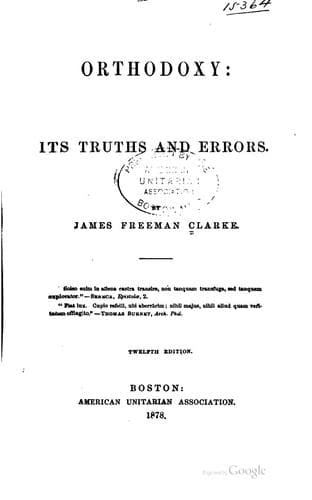
Orthodoxy: Its Truths And ErrorsClarke, James Freeman
Religion
Orthodoxy: Its Truths And Errors
Clarke, James Freeman
Unitarianism
“This is a true saying, and worthy of all acceptation, that Christ Jesus
came into the world to save sinners.” It is because we are sinners that we
need to experience this great change. We do not wish to exaggerate the
amount of human sinfulness. Theologians have carried their attacks on
human nature quite too far, and the result has often been that men have
looked on sin as a sort of theological matter, which has nothing to do
with actual life. They have cheerfully admitted that they were totally
depraved by nature, and could not think or will a good thing, and then
have thought no worse of themselves than before. We know that there is
something good in man, something which God loves, some pure aspiration
even in the natural heart, some throbs of generosity, some warnings of
conscience, some pure love, some courageous virtue, in the humblest, the
most depraved, the most abandoned. There are some flowers of sweetest
perfume which spring up in the uncultivated soil of the natural heart on
which God and his angels smile, for the seeds of those flowers God himself
planted. We have seen harebells, graceful and lovely as the sweetest
greenhouse plant, growing out of a sand-heap; and we have seen some
disinterested, generous benevolence in the mind of a hardened profligate.
It is not, therefore, because there is nothing good in man that he needs a
change of heart, but because he is destitute of a deep-rooted and living
goodness till this change has taken place.
Look at the _actual sins_ of men. The majority of men, in a civilized
community like ours, do not commit great crimes, or fall into flagrant
vices, because they have little to attract them to such a course, and much
to deter them from it. They are aiming at those objects which they need
the countenance, aid, and good opinion of their fellow-men to obtain, to
be glaringly vicious would make it impossible. Also, there is a certain
amount of conscience which restrains them—the influence of good education
and good habits which preserves a certain uprightness and purity of
character. But is it a deep principle? If so, why do the vast majority of
men allow themselves in many small violations of the same laws which they
would not break on a large scale? They would not steal; yet they commit
every day some slight acts not perfectly honest; they take advantage of
others in little things. They would not lie; yet they exaggerate, and
conceal part of the truth, and color their statements to produce an
effect. They would not kill; but they are willing to injure one who has
interfered with their interests. With these tendencies and feelings, why
would they not, under different influences, commit greater crimes? How
often do we feel, in talking with the criminal and abandoned, that, in
their circumstances and with their temptations, we might have been as bad
as they!
Public-domain text, read in full here on John Shaqi.
Reviews
Reviews
No reviews yet
Be the first to share your thoughts on this work.
Elsewhere in the archive
Join the Discussion
Join the discussion
Sign in to leave a comment or review.
Sign InorCreate an account