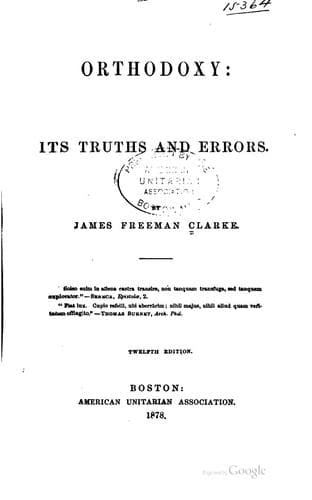
Orthodoxy: Its Truths And ErrorsClarke, James Freeman
Religion
Orthodoxy: Its Truths And Errors
Clarke, James Freeman
Unitarianism
The question is sometimes asked, “whether sin is a positive or merely a
negative evil.” Now, whatever may be the case with other kinds of sin,
this alienation of the heart seems to us a very positive evil; for it is
an antagonism, and resistance of goodness. If the supreme goodness of God
does not attract us, does not excite our affection, does not irresistibly
draw us to him, then it repels us; it makes the thought of his presence a
restraint and burden; it makes us wish to go away from God. The goodness
of God is so very positive a thing, that we cannot be indifferent to it;
we cannot be neutral in regard to it. If we do not love it, it is
disagreeable, and we are uncomfortable in the thought of it. Swedenborg
relates that certain wicked persons were allowed to enter heaven on a
certain occasion; but they immediately became almost lifeless, and, from
the torment and pain in their head and body, prostrated themselves on the
ground, and writhed like worms; but, being taken and carried into hell,
became comparatively comfortable. What can be more terrible than the idea
thus conveyed of our aversion to goodness, which makes heaven intolerable,
and the presence of God insufferable torture! Can anything express, more
than this, the need of a change of heart?
Jesus, we think, asserts a similar view when he says, “He that is not with
me is against me.” “No man can serve two masters; for he will either love
the first and hate the last, or love the last and hate the first.” He will
not be indifferent to either, if their characters and commands are of an
opposite kind.
We do not mean to say that we _hate_ God; but we mean that there is
something within us, while our hearts are not wholly his, which makes it
unpleasant and burdensome to think of God and pray to him. We feel a
certain repugnance to a familiar and happy intercourse with our heavenly
Father. Our prayers, if we pray, are formal and cold; our hearts are hard,
and their affections do not flow easily upward.
Now, if there be such a thing as a change of heart, which will make it a
pleasure to pray, a joy to think of God; which will make it natural to us
to approach him, and dwell on the thought of his goodness; which will
enable us to see him in the majesty and sweetness of nature, in the rise
of empires or the death of an infant, in the coming of Christ, and in
every good thought which swells in our souls,—then it is evident that this
is what we need. Let us dig deep, and build our house upon a rock.
Public-domain text, read in full here on John Shaqi.
Reviews
Reviews
No reviews yet
Be the first to share your thoughts on this work.
Elsewhere in the archive
Join the Discussion
Join the discussion
Sign in to leave a comment or review.
Sign InorCreate an account