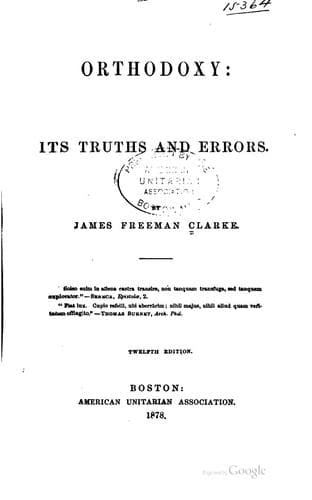
Orthodoxy: Its Truths And ErrorsClarke, James Freeman
Religion
Orthodoxy: Its Truths And Errors
Clarke, James Freeman
Unitarianism
We shall see in another section that there is such a change of heart as we
have described. Jesus saves sinners by taking away the heart of stone, and
giving a heart of flesh. He saw the whole depth and extent of the disease
which he came to cure. There are some preachers who do not know how great
an evil sin is, and would not know what to do for a penitent and anxious
soul which really saw the greatness of its needs. Thus, when George Fox
went to the rector of his church to ask advice for the distress of his
soul, he was told to amuse himself and divert his mind. But Jesus saw all
the extent of sin, and yet was ready to encourage and help the sinner. He
knew that his remedy was equal to the emergency. The gospel of Christ can
give to us love to God and love to man; can soften our hearts in humility,
can enable us to fight with and conquer even the hereditary evil of our
organization; can ultimately redeem us from all evil. This is the
depravity we are to conquer; not of nature, but of will, and aim, and
purpose.
§ 10. Ability and Inability.
One of the pivotal points in the Orthodox theory of evil is that of _moral
inability_. Indeed, the doctrine of total depravity seems to be taught for
the sake of this. Total depravity resolves itself, in the mind of the
Orthodox teacher, into total inability, and means that man, unable to do
right by any power in himself, must throw himself wholly and absolutely on
the divine grace. The secret motive of the whole Orthodox doctrine of evil
is to lead through a sense of sin to humility, and at last to dependence.
Orthodoxy here becomes intelligible, so soon as we perceive that its
purpose is not speculative, but practical. As religion consists so greatly
in the sentiment of dependence, it is a leading purpose in the Orthodox
system to produce this sense of dependence. That group of
graces—reverence, humility, submission, trust, prayer—which lend such an
ineffable charm to the moral nature, which purify and refine it to its
inmost depths,—these spring almost wholly from the sense of dependence on
a higher and better being than ourselves. These being absent, the
elevating principle is wanting; the man cannot rise above himself. There
may be truth, courage, conscience, purity, but they are all stoical and
self-relying. It is only he who relies on a higher power, clings to a
higher being, and draws his moral life from above, who can ascend. He who
humbles himself, and he only, shall be exalted. But humility does not
consist in looking down, but in looking up. It does not come from looking
at our own meanness, but at something higher and better than ourselves.
The sense of sin is only elevating when connected with the sight of a
higher beauty and holiness.
Public-domain text, read in full here on John Shaqi.
Reviews
Reviews
No reviews yet
Be the first to share your thoughts on this work.
Elsewhere in the archive
Join the Discussion
Join the discussion
Sign in to leave a comment or review.
Sign InorCreate an account