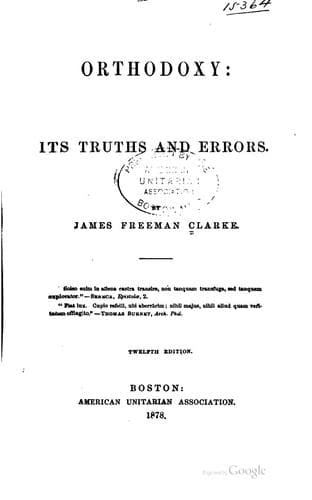
Orthodoxy: Its Truths And ErrorsClarke, James Freeman
Religion
Orthodoxy: Its Truths And Errors
Clarke, James Freeman
Unitarianism
and doing wrong, he feels himself a slave.
There are therefore these three conditions of the will, corresponding to
the Pauline division of man into spirit, soul, and body (1 Tim. 5:23)—a
view of man which was held throughout antiquity. The carnal man (σαρκικος)
is one in whom the earthly appetites are supreme, and the soul, (ψυχη) and
spirit (πνευμα) subordinate. The natural man (ψυχικος ανθρωπος, 1 Cor.
2:14) is one in whom the soul, or central principle, the finite will, is
supreme. The spiritual man (πνευματικος, 1 Cor. 2:15) is he in whom the
infinite principle, the sense of eternal truth and right, is supreme. In
the first condition—that of the carnal man—one is the slave of sin, but
without knowing it, because there is no wish to become anything different.
In the second state—that of the natural man (or psychical man)—the soul
chooses the good, but is drawn down by the evil. The law of the mind is
warring against the law of the members, and the man is torn asunder by
this conflict. He tries to do right, and does wrong. He now first feels
himself a slave; yet he is in reality _less_ a slave than before, for now
he is endeavoring to escape. His _will_ is emancipated, though his habits
of conduct, his habits of thought, his habits of feeling, still bind him
fast. In the third condition, that of the spiritual man, he has broken
these chains. He not only wills to do right, but does it. His body shares
in the new life of his soul. He now is made free by the truth and the
spirit from the service of evil, and shares in “the glorious liberty of
the children of God.”
In all these conditions the human being has some freedom, but differing in
degree in each. In the lowest state he has freedom of action, for he does
what he wishes to do; but he has not freedom of choice, for he does not
choose at all. He acts not by intelligent choice, but by blind instinct,
habit or custom. In the middle state he has freedom of choice, but not of
action. He chooses the good, but performs the evil. This is the condition
described by Ovid, and other profane writers, before Paul described it in
the seventh chapter of Romans.(15) But in the highest state—a spiritual
condition—he has both freedoms; he can both choose and perform. The carnal
man seems to be free, but is most thoroughly enslaved of all. The
psychical man seems to himself to be enslaved, but has begun to be free.
The spiritual man both seems to be free and is so. The apparent freedom of
the carnal man differs from the real freedom of the spiritual man in
this—the spiritual man could do wrong if he chose to do so, but chooses to
do right. But the carnal man could not do right if he should choose. A
good man, if he chose to do so, might lie, and steal, and drink, and be
profane; but a bad man could not, by choosing, become temperate, pure,
truthful, and honest.
Public-domain text, read in full here on John Shaqi.
Reviews
Reviews
No reviews yet
Be the first to share your thoughts on this work.
Elsewhere in the archive
Join the Discussion
Join the discussion
Sign in to leave a comment or review.
Sign InorCreate an account