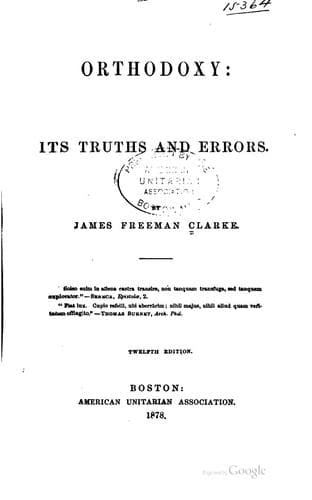
Orthodoxy: Its Truths And ErrorsClarke, James Freeman
Religion
Orthodoxy: Its Truths And Errors
Clarke, James Freeman
Unitarianism
It is, therefore, in order to produce a conviction of absolute dependence
that Orthodoxy urges so strongly the doctrines of total depravity and
total inability. A man will not pray, says the Orthodox system, till he
feels himself helpless. He will not seek a Saviour so long as he hopes to
save himself. He must see that he can do nothing more for himself; and
then, for the first time, he exercises a real faith in God, and casts
himself on the divine mercy.
Reasoning in this way, consciously or unconsciously, Orthodoxy has built
up its doctrine of human inability, which we will proceed to state,—first,
however, indicating the scriptural view of this subject.
Scripture teaches that man is able to choose the right, but not always
able to perform it. He is free in his spirit, but bound by circumstances
of position, and by bodily organization. He is free to choose, but not
free to do. His freedom is in effort, not necessarily in accomplishment.
He can always try; he cannot always effect what he tries.
Thus Jesus says (Matt. 26:41), “Watch and pray, that ye enter not into
temptation; the spirit indeed is willing, but the flesh is weak.” And so
Paul says, in the passage on this subject before referred to (Rom. 7:18),
“To will is present with me, but how to perform that which I will, I find
not.”
Without attempting here to enter into the tormented question of fate and
freedom, of necessity so irrefragably demonstrated by the logic of Edwards
and others,—of free-will perpetually reasserted by the intuitive reason in
the soul,—we may say this: Whether there be such a thing as metaphysical
freedom or not, there is such a thing as moral freedom. In proportion as
man sinks into the domain of nature, he is bound by irresistible laws. In
proportion as he rises into the sphere of reason, justice, truth, love, he
is emancipated, and can direct his own course. “Ye shall know the truth,
and the truth shall make you free.” “If the Son, therefore, shall make you
free, ye shall be free indeed.” (John 8:32, 36.) “Stand fast in the
liberty wherewith Christ hath made us free.” (Gal. 5:1.) It is therefore
true that only as we direct our course by eternal laws, we rise above the
controlling influence of habit, prejudice, public opinion, inherited and
original tendencies of the blood and brain. According to Paul (Rom.
6:16-22), man must be either the servant of sin or the servant of God. He
must serve, willingly or unwillingly. He must be the degraded slave of
desire and selfishness, or the willing, loyal subject of truth and right.
Paradoxically enough, however, he only feels free in these two cases. For
in these two states he is doing what he chooses to do. When he is blindly
and willingly following his lower instincts he feels free. When he is
rationally and freely choosing right, and doing it, he also feels free.
But when half way between these two states, when his conscience is pulling
one way and his desires drawing him the other, when he is choosing right
Public-domain text, read in full here on John Shaqi.
Reviews
Reviews
No reviews yet
Be the first to share your thoughts on this work.
Elsewhere in the archive
Join the Discussion
Join the discussion
Sign in to leave a comment or review.
Sign InorCreate an account