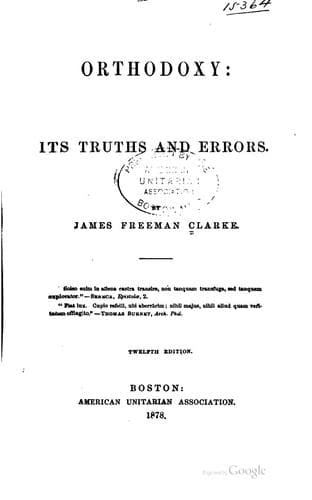
Orthodoxy: Its Truths And ErrorsClarke, James Freeman
Religion
Orthodoxy: Its Truths And Errors
Clarke, James Freeman
Unitarianism
(_a._) _The Old School Presbyterians._—As stated by one of their own
number (Professor Atwater, of Princeton College, Bibliotheca Sacra,
January, 1864), they hold an inability “moral, sinful, and real,”
“irremovable by the sinner’s own power.” He sets aside the objection that
we are not bound to do what we are unable to do, by saying that this
applies to actions only, not to sinful dispositions. He illustrates this
by saying that an irrepressible disposition to slander would be only so
much more culpable. But in this he is evidently wrong. Such a habit has
become a disease, and the unfortunate victim is no longer accountable for
what he does.
(_b._) _The New School Presbyterians._—(Rev. George Duffield, in
Bibliotheca Sacra, July, 1863.) Although Dr. Duffield objects to the
language of the Old School Presbyterians in denying “free agency,” and
regarding man “as destitute of ability as a block of marble,” he yet
declares that the New School, as well as the Old, believe that in the
unconverted state “man can do nothing morally good.” Still, he adds, men
can accept the offers of salvation made by Jesus Christ. But he positively
denies that “man, in his natural state, independent of the gospel and
Spirit of Christ, has ability _perfectly_ to obey _all_ the commandments
of God.” We suppose that most persons would agree with him in this
statement.
(_c._) _The Old School in New England Theology._—(Bibliotheca Sacra,
April, 1863. Article by Professor Lawrence, East Windsor, Connecticut.)
This writer contends that human inability is moral, and not natural—a
distinction much dwelt upon by the Hopkinsians, but rejected by the Old
School Presbyterians. This system differs from the Arminian or Methodist
view in insisting that man has power enough to sin, though not enough to
obey.
(_d._) _Hopkinsianism._—(Bibliotheca Sacra, July, 1862.) The Hopkinsians
profess to contend for free agency, in order to save responsibility. They
adopt the ideas of Edwards on free agency. But freedom, with them,
consists only in choice. Whatever we choose, we choose freely. The carnal
man is as free in choosing evil as the spiritual man in choosing good. All
real freedom in this system disappears in a juggle of words.
Public-domain text, read in full here on John Shaqi.
Reviews
Reviews
No reviews yet
Be the first to share your thoughts on this work.
Elsewhere in the archive
Join the Discussion
Join the discussion
Sign in to leave a comment or review.
Sign InorCreate an account