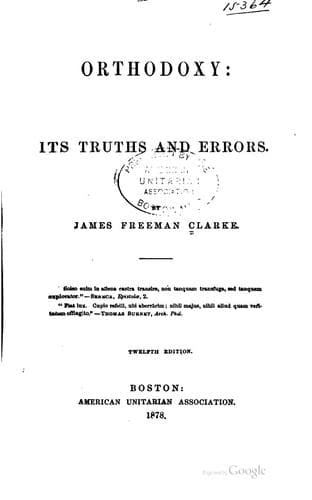
Orthodoxy: Its Truths And ErrorsClarke, James Freeman
Religion
Orthodoxy: Its Truths And Errors
Clarke, James Freeman
Unitarianism
The result of this examination will show that the great body of the
Orthodox, of all schools, continues to deny any real ability in the
unregenerate man to do the will of God. They do not _say_ that “man has no
power to do his duty,” but that is the impression left by their teaching.
The distinction between natural and moral inability is insufficient; for
it is as absurd to say that a man is unable not to sin, when you only mean
that he chooses to sin, as it would he to say, when invited to eat your
dinner, “I am unable to eat,” meaning only that you were unwilling.
Besides, if inability is moral, it is in the will, and not in the nature,
and so is not natural depravity at all. It is also making God unjust to
teach that he considers us guilty for a misfortune. If we derive a
corrupted nature from Adam, that is our misfortune, and not our fault, and
God owes us not anger, but pity. Instead of punishing us, he should
compensate us for this disaster.
Therefore the unreason, the want of logic, and the absence of any just
view of God, appear, more or less, throughout these statements. For where
there is no ability, there can be no guilt. Just as soon as man ceases to
have the power to do right, he ceases to have the power to do wrong.
Inability and guilt, which are connected by all these creeds, logically
exclude each other. If our nature is incapable of doing good, then it is
incapable of committing sin. One or the other must be given up. Keep which
you will, but you cannot keep both. We may be totally depraved by our
nature; but then we cease to be sinners, and cease to be guilty. Or we may
be going wholly wrong, and so be sinful, but then we have the power of
going right.
This is the inconsistency in almost all Orthodox systems. By dwelling so
much on human weakness, they destroy at last the sense of responsibility.
§ 12. Some further Features of Orthodox Theology concerning Human
Sinfulness.
In the article in the Bibliotheca Sacra before referred to (April, 1863),
by Edward A. Lawrence, D. D., Professor at East Windsor, Connecticut, on
“The Old School in New England Theology,” the writer gives the following
account of the doctrines of this body concerning sin:—
“God created man a holy being. He was not merely innocent, as not having
committed sin, not merely pure, as not inheriting any derived evil, but
was positively holy in his very being.” This, we suppose, must mean that
he was inclined by nature to do right, rather than wrong. It was as
natural for him to love God as for a fish to swim or a bird to fly.
Nothing less than this, certainly, would deserve to be called “holiness of
being.”
“The first man,” says Professor Lawrence, “was the federal head of this
race, representatively and by covenant, as no other father has been or can
be with his children.” This is illustrated by the fact of a legal
corporation, whose members are responsible in law for the actions of their
agent.
Public-domain text, read in full here on John Shaqi.
Reviews
Reviews
No reviews yet
Be the first to share your thoughts on this work.
Elsewhere in the archive
Join the Discussion
Join the discussion
Sign in to leave a comment or review.
Sign InorCreate an account