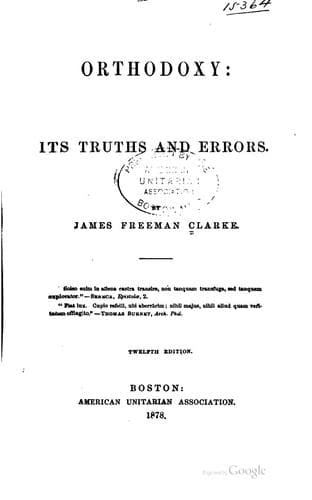
Orthodoxy: Its Truths And ErrorsClarke, James Freeman
Religion
Orthodoxy: Its Truths And Errors
Clarke, James Freeman
Unitarianism
First. If original righteousness was holiness of nature, and not mere
innocence; if it was a positive tendency to good, and not merely a state
of indifference between good and evil; then, we ask, What produced the
fall? What motive led to the commission of the first sin? If the nature of
the first man was holy, there was nothing in it which could lead him to
sin, and any external temptation addressed to such a nature must fall
powerless before it. It would be like trying to tempt a fish to fly in the
air, or like tempting a bird to go into the water. Even if the first man
could have been induced by any deception or external influence to commit a
wrong act, this would not be sinful, because there would be no sinful
motive behind it. A wrong act proceeding from a holy nature is either an
impossibility or a mere innocent mistake. Our first criticism, therefore,
on the Old School doctrine of sin, is, that it makes Adam’s fall an
impossibility.
Second. As regards Adam’s federal headship and the illustration of a
corporation, we say, that the members of a corporation are not considered
guilty in consequence of the acts of their agent, although they may suffer
in consequence of these acts. If he commits forgery they may lose money
thereby, but no one would think of calling them forgers. The sin of a
parent may be visited upon his children to the third or fourth generation,
but in their case it is neither punishment nor guilt, but only misfortune.
When Professor Lawrence, therefore, says, that “we are guilty for the
sinfulness with which we are born, because it is really ours,” he utters a
moral absurdity, and strikes at the root of all moral distinctions. He
says, “The sinfulness with which we are born is really ours;” but in what
sense ours? Only as any congenital disease may be called _ours_. If a man
is born with a tendency to consumption, blindness, lameness, he may say,
“my lameness, my near-sightedness.” But no one would suppose that he meant
thereby to hold himself responsible for them, or to consider himself
guilty because of them. It is absurd to speak of “corporate guilt.” The
corporate guilt, for example, of the stockholders of a bank, because of
the crime of an absconding teller!
Public-domain text, read in full here on John Shaqi.
Reviews
Reviews
No reviews yet
Be the first to share your thoughts on this work.
Elsewhere in the archive
Join the Discussion
Join the discussion
Sign in to leave a comment or review.
Sign InorCreate an account