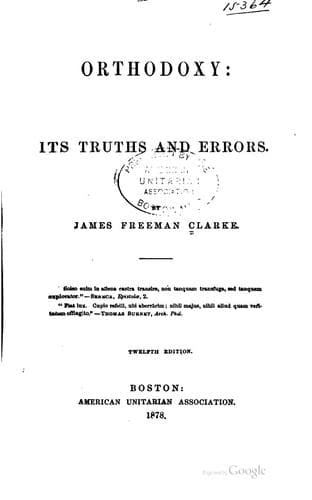
Orthodoxy: Its Truths And ErrorsClarke, James Freeman
Religion
Orthodoxy: Its Truths And Errors
Clarke, James Freeman
Unitarianism
The natural objection to this illustration of a corporation is, that those
who enter into a corporation do it by a free act, and make themselves
voluntarily responsible. But _we_ did not consent that Adam should be our
agent. We did not agree that if Adam should commit a single act of
disobedience we should be born totally depraved, and liable to everlasting
torments in consequence. Professor Lawrence replies, that it would have
been impossible for God to ask our consent, and therefore, apparently he
supposes that God took for granted that we would consent. This seems to be
no answer to the objection. If it was impossible for God to obtain our
consent, before we were born, to incur this awful danger, he was not
compelled to expose us to it. It is an insult to the justice of the
Almighty to assume that he could have done so.
Third. Professor Lawrence does not think it correct to say that “sin is a
nature.” But why not, if it be a universal and constant element, an
original and permanent state of the soul? To say that human nature is
sinful, but deny that sin is a nature, seems to be making a distinction
without a difference. It is a disposition to sin born with the child. Now,
say what we will, such a disposition to sin thus born with us is not guilt
but misfortune. A just God will not hold us responsible for it, but will
hold himself responsible to help us out of it. As a faithful Creator, he
is bound to do so, and will do so.
It is common for theologians to deny all such assertions as these last.
They hold it irreverent to say that God owes anything to his creatures.
They accumulate responsibility upon man, but deny responsibility to God.
But in doing this they take from the Almighty all moral character.
Calvinism, especially, makes of the Deity infinite power and infinite
will. But no blasphemy is worse than that which, though with the best
intentions, virtually destroys the moral character of the Almighty,
reducing him to an infinite will: that is, making of him an infinite
tyrant. For the essence of tyranny is the union of power and will in a
ruler, who recognizes no obligations towards his subjects.
Public-domain text, read in full here on John Shaqi.
Reviews
Reviews
No reviews yet
Be the first to share your thoughts on this work.
Elsewhere in the archive
Join the Discussion
Join the discussion
Sign in to leave a comment or review.
Sign InorCreate an account