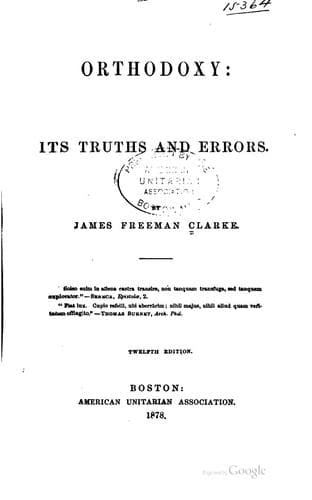
Orthodoxy: Its Truths And ErrorsClarke, James Freeman
Religion
Orthodoxy: Its Truths And Errors
Clarke, James Freeman
Unitarianism
The book of Job seems to have been written partly to refute this sort of
Calvinism. The friends of Job were Calvinists in this sense. The sum of
their argument was that, since God was all-powerful, therefore whatever he
did must be right; and, since he punished Job, Job must be a sinner, and
ought to confess his sin whether he saw it or not. This has been, in all
ages, the substance of Calvinism—Jewish Calvinism, Mohammedan Calvinism,
Christian Calvinism. It declares that we are bound to submit to God, not
because he is good, but because he is powerful. But the answer of Job to
his friends is a rebuke to the same spirit wherever shown. He asks them
“if they will speak with unfairness for God,” and “speak deceitfully for
him,” and “accept his person.” He declares that if he could find God he
would go before his throne and defend his own cause. “Would he contend
with me with his mighty power? No! he would have regard unto me.”
This is the sin of Calvinism, that it “accepts the person of the
Almighty,” assuming that he has a right to do as he pleases with his
creatures, and that they have no rights which he is bound to respect,
except that of being punished. Thus it destroys the moral character of the
Almighty.
Fourth. Professor Lawrence says, “It is the general belief of the Old
School that those who die in infancy before actual transgression, are
renewed and saved by the blood of Christ.”
The power of infancy is wonderful. It can even break down the logic of
Calvinism. Wordsworth was right in calling the infant—
“Mighty prophet! Seer blest!
On whom those truths do rest
Which we are toiling all our lives to find.”
Public-domain text, read in full here on John Shaqi.
Reviews
Reviews
No reviews yet
Be the first to share your thoughts on this work.
Elsewhere in the archive
Join the Discussion
Join the discussion
Sign in to leave a comment or review.
Sign InorCreate an account