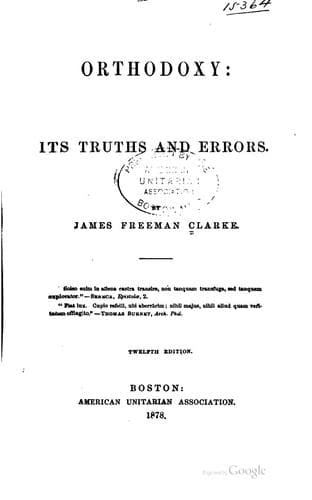
Orthodoxy: Its Truths And ErrorsClarke, James Freeman
Religion
Orthodoxy: Its Truths And Errors
Clarke, James Freeman
Unitarianism
But why is it any worse for children to be damned in consequence of Adam’s
sin than for adults to be damned? Orthodoxy assures us that in consequence
of Adam’s sin we are born depraved. Dr. Duffield, stating and defending
the doctrines of the New School Presbyterian Church (Bibliotheca Sacra,
July, 1863), says that Adam subjected his posterity to such a loss that
they are born without any righteousness, are exposed to the consequences
of his transgression, and all become sinners as soon as they are capable
of it. He quotes with approbation from a protest of the New School
minority, in the General Assembly of 1837 (which he calls a document of
great historic value), an assertion that “by reason of the sin of Adam,
the race are treated as if they had sinned;” and from another document of
the same school which says, that “we are all born with a tendency to sin,
which makes it morally certain that we shall do so.” Now, we do not see
why it is any worse to send infants to hell because of this depraved
nature, than to send grown persons there who have sinned in consequence of
possessing such a depraved nature. If it be said that adults have had an
opportunity to repent, and have not accepted it, we reply, that to the
mass of mankind no such opportunity is offered; that, where it is offered,
no one has the power to accept it, except he be one of the elect; and that
at all events, since infants are sure to be saved, and a very large
proportion of adults are very likely to be lost, _death in infancy is the
most desirable thing possible_. According to this doctrine, child-murder
becomes almost a virtue.
The radical difficulty in all these theories consists in refusing to apply
to God the same rules of justice which we apply to man. To do so implies
no irreverence, but the highest reverence. There is nothing more honorable
to the Almighty than to believe him to be actuated by the same great
principles of right which he has written in our conscience and heart.
Those laws of eternal justice, so deeply engraven on the fleshly tables of
the heart, are a revelation of the character of God himself. If we think
to honor him by rejecting these intuitions of the reason, and by
substituting for this divine idea of a God of justice that of a being of
arbitrary will, who is under no obligations to his creatures, we deeply
dishonor the Almighty and fatally injure our own character. From this
perverted view of God comes a cynical view of man. When we make _will_
supreme in God, we legitimate all tyranny and contempt from man to man.
Then comes the state of things described by Shakespeare:—
Public-domain text, read in full here on John Shaqi.
Reviews
Reviews
No reviews yet
Be the first to share your thoughts on this work.
Elsewhere in the archive
Join the Discussion
Join the discussion
Sign in to leave a comment or review.
Sign InorCreate an account