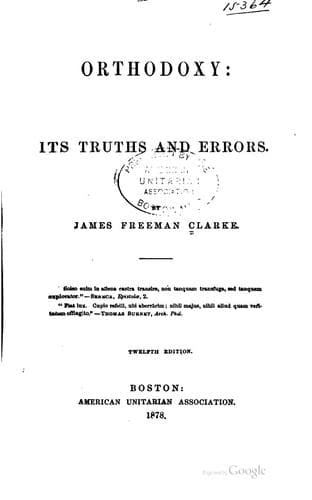
Orthodoxy: Its Truths And ErrorsClarke, James Freeman
Religion
Orthodoxy: Its Truths And Errors
Clarke, James Freeman
Unitarianism
“Force should be right, or, rather, right and wrong
(Between whose endless jar justice resides)
Should lose their names, and so should justice too.
Then everything includes itself in power,
Power into will, will into appetite;
And appetite, a universal wolf,
So doubly seconded with will and power,
Must make perforce a universal prey,
And, last, eat up himself.”
_Shakespeare_, Troilus and Cressida.
CHAPTER VII. CONVERSION AND REGENERATION.
§ 1. Orthodoxy recognizes only two Conditions in which Man can be found.
Orthodoxy knows only two states in which man can be found. Man is either
in the natural state, and then he is totally depraved; or he is in the
supernatural state, in which the chain of sin has been broken. He is
either impenitent or penitent, either unregenerated or regenerate,
unconverted or converted, a sinner or a saint.
There is no gradation, no shading off, no twilight between this midnight
gloom and midday splendor. To the common eye, and in the judgment of their
friends and neighbors, the people who enter a church seem of all degrees
of goodness; and every one has good and bad qualities mixed up together in
his character. But, as the Orthodox minister looks at them from the
pulpit, they instantly fall into two classes, and become “my impenitent
hearers,” and “my penitent hearers.”
Moreover, it is assumed that the distinction between these two classes is
so marked and plain, that it can be recognized by any one who will.
Orthodox people inquire, “_Is he pious?_” just as they would ask, “_Is he
married?_”
Again, the change from one state to the other is assumed to be so distinct
and marked, that he who runs can read. One may say to another, “_Where
were you converted?_” just as they may say, “_Where did you go to
college?_” “Where were you born?” said an English bishop to Summerfield,
the Methodist preacher. “In Dublin and Liverpool,” he answered. “Were you
born in _two_ places?” said the bishop. “ ‘Art thou a master in Israel,
and knowest not these things?’ ” replied Summerfield.
On the other hand, it is quite common among Liberal Christians to doubt
the reality, or deny the importance, of such changes altogether. With them
the Christian life consists, not in change, but in progress. In the
Christian source, Orthodoxy lays the main stress on the commencement;
Liberal Christianity, on the progress. The one wishes you to begin the
journey, without seeming to care whether you go forward: the other urges
you to go forward, without inquiring whether you have begun to go.
According to one, Christianity is nothing but a CRISIS; according to the
other, nothing but a DEVELOPMENT.
§ 2. Crisis and Development.
Is there any truth in this Orthodox view of man? anything essential,
substantial, vital? And is there any formal error? If there is, what is
it? Is Christianity crisis or development, or both?
Public-domain text, read in full here on John Shaqi.
Reviews
Reviews
No reviews yet
Be the first to share your thoughts on this work.
Elsewhere in the archive
Join the Discussion
Join the discussion
Sign in to leave a comment or review.
Sign InorCreate an account