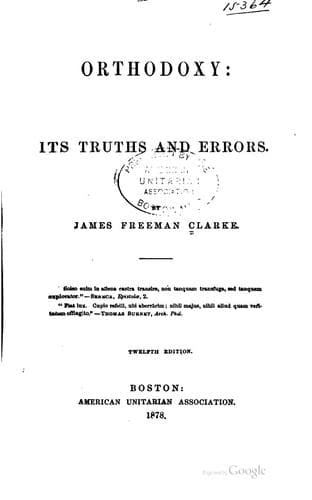
Orthodoxy: Its Truths And ErrorsClarke, James Freeman
Religion
Orthodoxy: Its Truths And Errors
Clarke, James Freeman
Unitarianism
We cannot but think the attitude of Orthodoxy towards this part of
Christianity to be singularly unsatisfactory and inefficient. The work of
the Church, all admit, is to convert the world to God, and so save it from
the power and evil of sin. But if this is a work which the Church has to
do, it ought surely to have some fixed method or rule by which to act. It
should not be a matter of accident whether it can do its work or not. It
should not be in doubt, every day, as to the success to come from its
efforts. If its work is to make men Christians, it ought to know how to do
it, be able to do it, and know when it is done. Such is the case with all
other work. If a man is to build a house, he does not bring together his
materials, hire his carpenters and masons, and, when all are on the
ground, sit down with them, and wait for some emotion or interior change
by which they will be enabled to go on and do their work. If we are
mechanics, merchants, lawyers, physicians, teachers, we do not wait for a
revival before we can properly fulfil our engagements. It is only in the
work of converting the world to God—the greatest and most important of
all—that such a strange system is adopted. We are told to put ourselves in
the proper place, namely, the Church; collect our materials, that is, the
means of grace; and then we are to wait until, somehow or other, we may be
able _to get religion_. Religion is made a spasm, a struggle, an agony—not
a regular work, not a steady growth. Everything about it is uncertain and
tentative. No one knows when he will become a Christian, but hopes, some
time or other, that he shall be made one. The common thought, produced by
the common Orthodox system of preaching, was expressed once in a public
meeting by Henry Clay. “I am not,” he said, “a Christian. I am sorry I am
not. I wish I were. I hope that, some day, I shall be.” He did not mean by
this to say that he was an unbeliever; but he had adopted the helpless,
passive system by which he was taught that he had nothing to do but wait
till some great change should take place in his soul.
Out of this way of thought comes the revival system, which is a curious
blending of machinery and expectation, of adroit and careful management
with reliance on some great inspiration. Crisis and development are to be
expected, no doubt; but we do not set a trap to catch the Spring. It is
ours to plant and to water, but it is God’s to give the increase. That,
therefore, should be left to him.
Public-domain text, read in full here on John Shaqi.
Reviews
Reviews
No reviews yet
Be the first to share your thoughts on this work.
Elsewhere in the archive
Join the Discussion
Join the discussion
Sign in to leave a comment or review.
Sign InorCreate an account