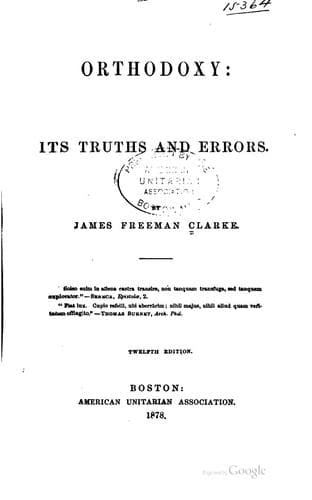
Orthodoxy: Its Truths And ErrorsClarke, James Freeman
Religion
Orthodoxy: Its Truths And Errors
Clarke, James Freeman
Unitarianism
Still more plainly does the apostle indicate the distinction when speaking
of those who are without law, those who are under law, and those who are
free from law and above it. The first state he describes in such words as
these: “I was alive without the law once”—the glad, natural life and
freedom before conscience is developed. But conscience does awake in all:
“The commandment came, sin revived, and I died.” When man sees that he
ought to serve God, yet continues to serve the flesh and the world, he is
spoken of as dead in sin; for all the principle of progress ceases. But if
he does endeavor to do right, then Paul speaks of him as _under law_, and
on his way to a higher state. That higher state he speaks of as being
“delivered from the law, to serve in newness of spirit, and not in oldness
of letter.”
Thus we see that all religious experiences coincide. The experience of the
apostle Paul is exactly the same, in its essentials, with that of every
soul, however humble, that begins and goes forward in the Christian life.
If this distinction between conversion and regeneration be correct, it
removes the difficulty in the Orthodox statement.
§ 8. Difference between Conversion and Regeneration.
Conversion is an act, regeneration an experience. “Turn ye, turn ye; for
why will ye die?” is the command of the Old Testament. “Repent, and be
converted, that your sins may be blotted out;” “Repent, and be baptized,
and ye shall receive the gift of the Holy Ghost,” is the command of the
New Testament. It is a duty to repent; but to become regenerate is not a
duty: _that_ is a gift, to be received afterwards. God commands
conversion: he bestows regeneration. Submission is an act of our own:
faith is the gift of God. A change of outward life and conduct we can
accomplish ourselves; at least, we can endeavor to accomplish it; but the
change of heart God himself will bestow.
Conversion, a turning round, is necessarily instantaneous: it is a change.
But regeneration, or reception of divine Love, is a state, not sudden, but
passing by gradations into a deeper and deeper life of faith and joy.
So, too, conversion may be repeated: we may often find that we have again
turned round, and are going the wrong way. But the inflow of life, when
begun, cannot be begun again. When God has touched the heart with his
love, it is forever lifted by that divine experience beyond the region of
mere law. We can never forget it. These are the:
“Truths which wake
To perish never;
Which neither listlessness nor mad endeavor,
Nor man nor boy,
Nor aught that is at enmity with joy,
Can utterly abolish or destroy.”
And herein lies the basis of the truth in the doctrine of the
“perseverance of saints.”
§ 9. Unsatisfactory Attitude of the Orthodox Church.
Public-domain text, read in full here on John Shaqi.
Reviews
Reviews
No reviews yet
Be the first to share your thoughts on this work.
Elsewhere in the archive
Join the Discussion
Join the discussion
Sign in to leave a comment or review.
Sign InorCreate an account