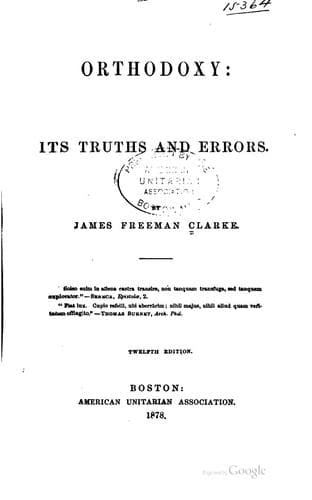
Orthodoxy: Its Truths And ErrorsClarke, James Freeman
Religion
Orthodoxy: Its Truths And Errors
Clarke, James Freeman
Unitarianism
All recollect the story of the Quaker, George Fox, how he went from Church
to Church, and got no good, and at last opened his soul to God, and was
led by the Spirit into new and strange thoughts and purposes, and became a
reformer, and founder of a denomination, unintentionally. And so the
Quaker movement came—the most radical reform which ever sprang up in the
Christian Church. It abolished the ministry and sacraments, baptism, and
the Lord’s supper. It reformed the theology of Christendom, putting the
inner light above the written words. It reformed life, opposing war,
oaths, slavery, and fashion. And as it came, so is it passing away, having
done its work. As the breeze dies softly, and the leaves cease to glitter
in the sunlight, and the red leaf on the top-most twig, far up in the sky,
leaves off its airy dance, and at last hangs motionless, so the wild air
which stirred in the depths of all hearts dies away in silence, and old
opinions and old customs resume their places, yet all purified and
changed. Only those which were so wholly dead that the wind blew them
entirely away, are gone forever.
So are the changes which come in human hearts, we know not whence or how.
It is a great mistake in the Church to have a stereotyped experience, to
which all must conform. Procrustes only lopped the limbs to suit the
measure of his bed; but these rules and moulds for the spiritual life, cut
down the new man, who is made by God’s Spirit, to the earthly standard of
some narrow stunted experience of other times. This it is “to grieve the
Spirit,” and to “quench the Spirit.” For God’s Spirit goes everywhere, and
where it goes it produces the best evidence of Christianity in sweet,
holy, Christian lives. It is the wind which blows where it will, which
does not run on a railroad through the sky, or stop at any particular
stations in the clouds, or go by any time-table. God’s Spirit comes and
goes not according to any rules of ours. The publicans and sinners have
it, and show it, sometimes, instead of the Scribes and Pharisees. For so
the apostle declares that there are “differences of operation, but the
same Spirit.”
Sometimes you see a hard man, a man of the world, who has been fighting
his way through life, till he has come to rely wholly on himself, and
feels like some of those rocky reefs which stand out in the sea on our New
England coast, and have borne the onset of a thousand storms. Yet at last
he is softened. We see it, we feel it. There is a strange softness in his
tone, a gentleness in his manner, a suspicion of moisture in his eye. The
good God has been moving in his heart; perhaps it was by some trial or
disappointment, or the loss of some curly-headed darling, who went up to
heaven, and left the doors open behind, so that the joyful music which
welcomed her came down to his ears and touched his soul.
When men see that, they say, “Well, there is something in religion, after
all, if it can touch such a heart as his.”
Public-domain text, read in full here on John Shaqi.
Reviews
Reviews
No reviews yet
Be the first to share your thoughts on this work.
Elsewhere in the archive
Join the Discussion
Join the discussion
Sign in to leave a comment or review.
Sign InorCreate an account