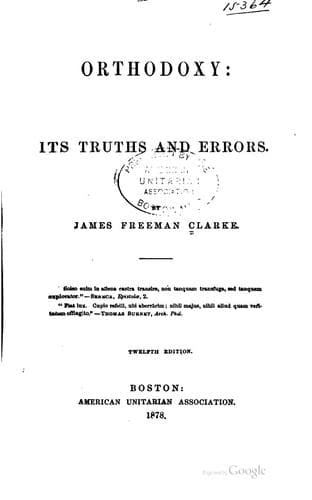
Orthodoxy: Its Truths And ErrorsClarke, James Freeman
Religion
Orthodoxy: Its Truths And Errors
Clarke, James Freeman
Unitarianism
Sometimes we see a Christian who is at first all conscience, all work.
Religion means to him, doing his duty. He intends to be a Christian, and
wishes others to be so. But it is a piece of hard work. His Christianity
reminds one of the poor woman who thought it “a chore to live.” But after
a while, we see a change—very gradual, but still very certain. He is
beginning to get acquainted with the gospel side of Christianity. He
learns to forgive himself his own sins, and so he can forgive others. His
face begins to reflect more and more of heaven. It is the change which
comes to the grapes in October. Perhaps you have some Catawba grapes on
the south side of your house, and they grow very nicely all through the
summer. They are good, large grapes well formed, good clusters, but very
sour. But by and by there comes the final change; the juice grows sweet
within the berry. There is but a very little difference in its appearance,
but a very great change _within_.
When we see this alteration in a man, we say, “There is surely something
in Christianity to produce such a change. Why, what a very sweet Christian
he has grown to be!” It took all the summer and part of the fall to do the
work; but no matter. God is not in a hurry. Some fruit ripens sooner, and
some later; that is all.
I looked up from my table as I wrote these words, and saw from my window a
tulip tree and a maple, each dressed in its royal robes of beauty—the gift
of the declining year; the green leaves of the one touched with gold, and
the other with its crimson and scarlet glories. They were full of
sunlight, and made the whole landscape glad and gay. No Tyrian loom could
rival the purple splendors and deep crimson of these trees. Why does God
give all this varied beauty to the October woods, so that Solomon in all
his glory was not arrayed like one of these oaks or maples? Is not this
also to touch our hearts with a sense of his love? An autumn ride is also
a means of grace; quite as much so, perhaps, as a tract or sermon. If we
see God in nature, then nature may also be the source of a new birth to
us.
“One impulse from the autumn wood
May teach us more of man,
Of moral evil and of good,
Than all the sages can.”
Public-domain text, read in full here on John Shaqi.
Reviews
Reviews
No reviews yet
Be the first to share your thoughts on this work.
Elsewhere in the archive
Join the Discussion
Join the discussion
Sign in to leave a comment or review.
Sign InorCreate an account