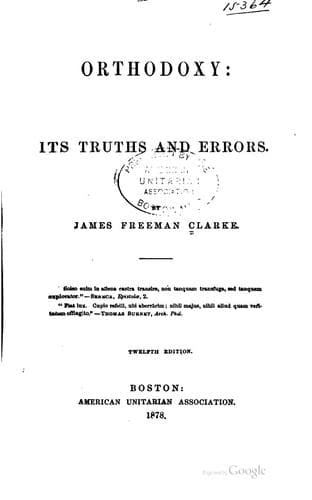
Orthodoxy: Its Truths And ErrorsClarke, James Freeman
Religion
Orthodoxy: Its Truths And Errors
Clarke, James Freeman
Unitarianism
But none of the great reformers of whom I have spoken, and no profound
theologians of any sect or school, have ever held the doctrines of
justification by faith in this way. Neither Luther nor Wesley ever made
faith synonymous with intellectual belief or opinion. “What is faith?”
said Wesley. “Not an opinion, nor any number of opinions put together, be
they ever so true. A string of opinions is no more Christian faith than a
string of beads is Christian holiness. It is not an assent to any opinion,
or any number of opinions. A man may assent to three or three and twenty
creeds, he may assent to all the Old and New Testament, and yet have no
Christian faith at all.”
But what is the true doctrine of justification by faith, as taught in the
Scriptures, and as inspiring these great reformers? This is naturally our
next inquiry.
§ 3. Need of Justification for the Conscience.
There is nothing in the nature of man more paradoxical than conscience. It
is that which lifts him to God; and yet it is that which makes him capable
of sin, and without which he could not be a sinner. It gives him the sense
of right, but at the same time makes him conscious of wrong. It makes him
capable of duty, but thereby also capable of disobedience. It shows us
what we ought to do, without giving us the least strength wherewith to do
it. It condemns us for not doing right, even when we have no power to do
anything but what is wrong. It shows us a great ideal of goodness to which
we ought to aspire, and discourages us by the very loftiness of the
standard. It tells us in the same breath that we are sinners, and that we
ought to be angels. It seems at the same time to elevate and degrade us.
It elevates us by giving a great object to life, and making it serious and
earnest; but it degrades us by making us constantly ashamed of ourselves,
and keeping us in a perpetual state of humiliation. Now, one of the chief
peculiarities of the conscience is, that beyond a certain point, the more
we try to obey it, the less satisfaction we have. We know that this is not
the usual theory. We are commonly told that the conscientious man is
always contented and happy,—satisfied with himself, and at peace with God.
But facts contradict this theory. The conscientious man is apt to be very
much dissatisfied with himself,—much, more so than the man whose
conscience is torpid and indifferent. There is comfort in faithful work;
no doubt there is great content in the steady performance of regular
duties; but here conscience is subordinate to work. It is _work_ which
gives contentment; but CONSCIENCE, when thoroughly roused by the strong
meat of a divine law, is the source of much self-dissatisfaction. How can
it be otherwise? It shows us that we ought to _love God and love man with
all our heart, soul, mind, strength_. Which of us does it? Do you? Do I?
How large a part of our life have we given to the service of God? how
Public-domain text, read in full here on John Shaqi.
Reviews
Reviews
No reviews yet
Be the first to share your thoughts on this work.
Elsewhere in the archive
Join the Discussion
Join the discussion
Sign in to leave a comment or review.
Sign InorCreate an account