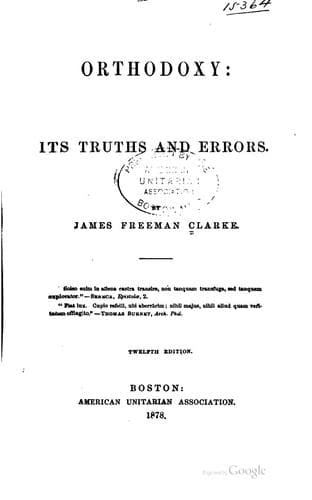
Orthodoxy: Its Truths And ErrorsClarke, James Freeman
Religion
Orthodoxy: Its Truths And Errors
Clarke, James Freeman
Unitarianism
We have shown that we may be mistaken in supposing this Orthodox doctrine
of justification to be of merely local and temporary interest, having no
permanent value. It is not likely that a man like Paul, of so large, so
deep, so philosophic a mind, should have devoted himself so earnestly, and
returned so fondly, to a theme involving no universal and eternal
principles, whose interest was to perish with the hour. It is not probable
that, in this small volume of writings of the new covenant,—this precious
gift of God to the world in all ages and in every nation,—so large a
portion should be devoted to a wholly temporary argument; and, more than
all, it is a most remarkable fact, that whenever there arises a man
uniting a deeper spirit of piety with a larger sense of liberty than other
men,—a man commissioned by God to give a new religious impulse to his age,
and to help Christianity to shake itself free from the cumbrous mass of
human forms and traditions which have crushed it, and to go forth in its
native grace and loveliness again,—some profound instinct should always
lead him to this doctrine as to a weapon effectual for pulling down the
strongholds of bigotry, scepticism, and spiritual death. Sir James
Mackintosh somewhere says, that the great movement which shook Christendom
to its centre, and did more to change and reform society than the
political revolutions and wars of a thousand years, originated with an
obscure Augustinian monk preaching the doctrine of justification by faith.
This acute Scotchman saw, what all must see who read Luther’s writings
with any attention, that it was no accident, no temporal interest, which
led him to lay such stress on this doctrine. It was the soul of his
preaching, the essence of his doctrine, the secret of his strength, the
life of his life. And so, when Wesley and the early Methodists were called
upon to pour new religious life into the English Church, they fell back on
this doctrine—this ancient sword of the Spirit. And so we may believe that
it has a value for all ages; that it did not relate merely to Jewish
usages, but is a principle of vital and everlasting application.
No doubt that if by faith we understand intellectual belief, or the assent
to opinions, and if by works we understand true obedience, and by
justification final salvation or actual goodness, there can scarcely be a
greater absurdity than to say that a man is justified by faith, and not by
works. To say that goodness, in the sight of God, consists in receiving
certain opinions, rather than in true obedience, is a most unscriptural
and irrational doctrine.
Public-domain text, read in full here on John Shaqi.
Reviews
Reviews
No reviews yet
Be the first to share your thoughts on this work.
Elsewhere in the archive
Join the Discussion
Join the discussion
Sign in to leave a comment or review.
Sign InorCreate an account