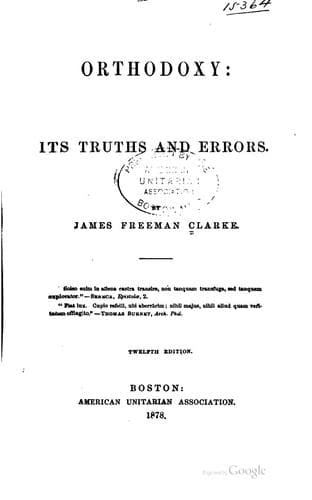
Orthodoxy: Its Truths And ErrorsClarke, James Freeman
Religion
Orthodoxy: Its Truths And Errors
Clarke, James Freeman
Unitarianism
Now, the consequences of sin are these: First, every act of sin brings
after it natural evil consequences. It weakens the strength of the soul,
it darkens the spiritual eye, it hardens the heart, it adds a new link to
the chain of evil habit. By a result as inevitable as the law of
gravitation, every act of sin pollutes, darkens, weakens the spiritual
principle in man. “He who sows to the flesh shall of the flesh reap
corruption.” We may call these results the _external_ consequences of sin,
because they change our spiritual relation and position in God’s external
universe. But there is another more awful and as inevitable consequence of
sin. It alienates us from God himself. It turns our face from the Source
of life and love. It makes us at war with him. It fills us with the sense
of his displeasure, and burdens us with the consciousness of guilt. To
escape the dreadful sense of his anger, we hide ourselves from him, as
Adam did. It is a law of the human mind that we dread the sight of any one
whom we have wronged, because it condemns us. Perhaps he may be perfectly
willing to forgive us; perhaps he does not even know that we have wronged
him; but we cannot bear to see him, notwithstanding. It was a profound
feeling of this law which led an ancient historian to say, “He hated him
because he had injured him.” Thus an active conscience, if it does not
make a man better, will make him worse: to escape its torture he will
plunge into new crimes. Some of the darkest crimes which stain the page of
history may be traced to this source,—to the operation of a conscience
strong enough to produce the sense of guilt, but not strong enough to
produce the determination to reform. It is related that when the mother of
Charles IX. of France and his uncles were urging the young king to consent
to the execution of some of the principal Protestants to whom he was
strongly attached, after a long resistance, when he at last gave way, it
was with these remarkable words: “I consent, then, but only on one
condition,—that you do not leave a Huguenot in France to reproach me with
it.”(18) And hence the Bartholomew Massacre, which its authors had
intended before only to include a few individuals. So sin takes occasion
by the law, and the commandment ordained for life becomes death.
The same principle operates with respect to God. We have broken his law.
We feel that he must be displeased with us; we therefore hide ourselves
from him, turn away from him, avoid the thought of him, are alienated from
him. This is the greatest evil of sin, and this we may call the inward
consequence of sin, because it affects our inward relation to God rather
than our outward relation to the universe.
And now, how are we to be reconciled to God? How are we to be freed from
this sense of guilt which falls on us in his presence, and makes us fear
and shun him?
§ 5. Different Methods of obtaining Forgiveness.
Public-domain text, read in full here on John Shaqi.
Reviews
Reviews
No reviews yet
Be the first to share your thoughts on this work.
Elsewhere in the archive