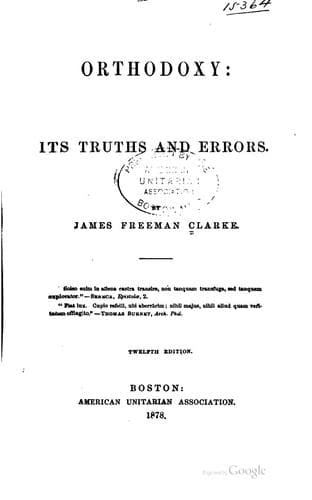
Orthodoxy: Its Truths And ErrorsClarke, James Freeman
Religion
Orthodoxy: Its Truths And Errors
Clarke, James Freeman
Unitarianism
There are two ways in which, when we have injured our brother, and so have
become estranged from him, we may become reconciled again, and freed from
a sense of shame in his presence. One is by endeavoring to atone for the
evil we have done by acts of kindness, by expressions of penitence. So at
last we may feel that we have done him far more good than evil; and though
he may not forgive us or be reconciled to _us_, we, on our part, may feel
freed from any shame in his presence, and be reconciled to _him_. The
other way is by _his_ coming to _us_, and _proving_ to us, by his conduct
and words, that he is not estranged from us by our bad conduct; that he
loves us as ever. So he will overcome our evil by his good, and reconcile
us to him.
The pagan nations in all ages and lands have taken the first way of being
reconciled to God. Oppressed by a guilty fear of their terrible idols,
they have brought as gifts to their altars what they had most valuable;
they have hung their gold, their jewels, in the temple; they have slain
their cattle on the shrine. Still unable to pacify their trembling hearts,
they have gone farther, and sought to prove the sincerity at least of
their repentance by self-inflicted tortures, and by giving even their
children’s lives to the bloody power whom they worshipped. Hence
sacrifices: they originated in the very same feeling which induces a man
to give a present to one whom he has wronged, to appease him.
Pagan religions are founded, therefore, wholly on the first mode of
reconciliation. The offending party comes to him whom he has injured, and
does something to pacify him. But these religions never brought peace to
the heart of the worshipper. After the wretched mother had dropped her
infant into the burning arms of Moloch, she still had no evidence that his
wrath was turned away.
In the religion of Moses, the first mode of reconciliation was united with
the second. Pitying the weakness of man, the law allowed him to bring his
sacrifice of birds or beasts or the fruits of the soil, and place it on
God’s altar as an expiation and atoning offering for his sin; and then,
the suppliant, having faith in the permanent presence of God in the holy
of holies, was received again to favor and assured of pardon. The Jew, who
had broken any of the laws of Jehovah, knew exactly what to do in order to
be reconciled to his national God and King. God had pointed out the way
which he would accept. By certain acts of sacrifice and restitution, the
Jew became once more worthy of living under the protecting care of
Jehovah.
Public-domain text, read in full here on John Shaqi.
Reviews
Reviews
No reviews yet
Be the first to share your thoughts on this work.
Elsewhere in the archive
Join the Discussion
Join the discussion
Sign in to leave a comment or review.
Sign InorCreate an account