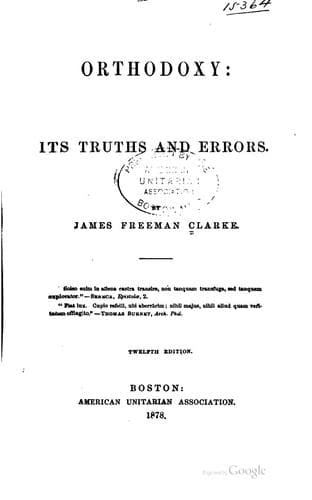
Orthodoxy: Its Truths And ErrorsClarke, James Freeman
Religion
Orthodoxy: Its Truths And Errors
Clarke, James Freeman
Unitarianism
But we are said to be reconciled by the death and blood of Christ. How is
this? We have seen the source of our alienation: it lay not in God, but in
ourselves. God had not gone away from _us_; we went away from him. He had
not ceased to love us; but by a terrible reaction from our sinfulness, we
had ceased to believe in his love. “God’s hand,” says the prophet (Isa.
59:2), “is not shortened, that he cannot save, nor is _his_ ear grown
dull, that he cannot hear; but _your_ iniquities have separated you from
your God, and your sins have hidden his face from you, that he doth not
hear.” By an immutable law of our mind, God’s wrath abides on us, and we
cannot believe in his love. Here is the source of our alienation. Now,
merely to be told that God is merciful does not wholly help the matter.
True, we say, He _is_ merciful, but not to _us_; we have sinned too long
and deeply. Something must be done, then, to _convince_ us that God is
ready to forgive and receive us freely. The death of Christ is the fact
which produces this conviction. The death of Christ, therefore, is not
merely an _emblem_ of God’s love, but an _act_ of God’s love. It draws us
to him. It changes our hearts. It melts our doubt, our distrust. It
reveals to us our Father’s love. The blood of Christ makes those who were
afar off nigh. This all experience teaches as a _matter of fact_. It is
the cross of Christ, borne by the simple missionary, preached by the
devout Moravian, which, amid the ice of Greenland or beneath the burning
sun of the tropic, reconciles the sinner to God.
And if one asks _how_ the death of Christ does this, we will briefly
indicate what we believe to be the way in which it operates. We look at
Christ, and see the brightness of God’s glory and express image of his
person. We see a holiness pure and perfect, a character infinitely
beautiful and lovely. We see how dear and near such a one must have been
to God; and we hear God say, “This is my beloved Son, in whom I am well
pleased;” and we hear him say of God, “My Father has not left me alone;
for I do _always_ the things which please him.”
Public-domain text, read in full here on John Shaqi.
Reviews
Reviews
No reviews yet
Be the first to share your thoughts on this work.
Elsewhere in the archive
Join the Discussion
Join the discussion
Sign in to leave a comment or review.
Sign InorCreate an account