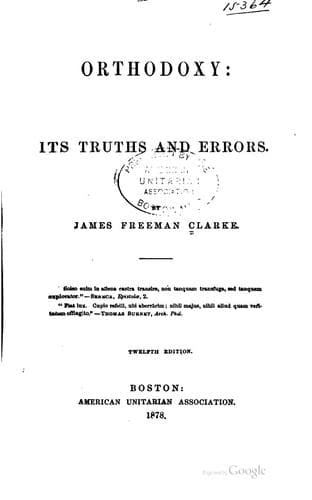
Orthodoxy: Its Truths And ErrorsClarke, James Freeman
Religion
Orthodoxy: Its Truths And Errors
Clarke, James Freeman
Unitarianism
And now we look at the world, and see it “lying in wickedness;” we see men
trampling on God’s law, polluting his image, cruelly oppressing each
other, and boldly defying and mocking at the Almighty. What does he then?
For the sake of these miserable, weak, and wretched sinners, who seem
scarcely worth the saving, he sends his holy child among them; he sends
this pure being to have his heart rent with the sight and knowledge of
human sin; he sends him to be cruelly and shamefully killed by a death of
agony, in order that _we_, sinful and miserable, may be reconciled. We
say, in the view of all this, “He who spared not his own Son, but
delivered him up for us, how shall he not _with_ him freely give us all
things?” We say, “God commended his love towards us, in that, while we
were sinners, Christ died for us.” “Herein is love; not that we loved God,
but that he loved us.” Christ, “being lifted up, draws all men unto him.”
Thus, in the midst of the gloom of that horrible scene on Calvary, when
the power of darkness was at its height,—that crisis of the world, when
human sin stood at the flood,—the heavens were opened, and a new ray of
divine love poured into the world.
§ 7. Result.
Let us sum up, then, the doctrine of justification by faith, as we have
now explained it.
1. JUSTIFICATION is not the doing away with all the consequences of sin,
but only the consequence which consists in present alienation from God. It
is objectively, as a divine act, what _forgiveness_ is subjectively, as a
human experience. It relates to _present_ acceptance with God; it is not
the cancelling of the results of our past sins on the character, nor is it
the hope of future salvation. It relates to the _present_.
The following passages show that justification is equivalent to
reconciliation or forgiveness. Rom. 5:8-10: “But God commendeth his love
toward us, in that, while we were yet sinners, Christ died for us. Much
more then, being now justified by his blood, we shall be saved from wrath
through him. For if, when we were enemies, we were reconciled to God by
the death of his Son, much more, being reconciled, we shall be saved by
his life.” Rom. 4:6-8: “David also describeth the blessedness of the man
unto whom God imputeth righteousness without works; saying, Blessed are
they whose iniquities are forgiven, and whose sins are covered. Blessed is
the man to whom the Lord will not impute sin.”
2. FAITH is not mere intellectual belief or opinion; nor is it mere
feeling, nor a mystical emotion in which we are wholly passive; but a
sentiment, in which belief, feeling, and determination are blended
together. The belief is that Christ is the Son of God; the feeling is
trust and joy in the love of God seen in him; and the determination is to
rely on him as a Mediator and Saviour.
That faith is not a mere intellectual belief, but involves also a feeling
of trust, appears from such passages as these: “If thou believe in thy
heart;” “An evil _heart_ of unbelief.”
Public-domain text, read in full here on John Shaqi.
Reviews
Reviews
No reviews yet
Be the first to share your thoughts on this work.
Elsewhere in the archive
Join the Discussion
Join the discussion
Sign in to leave a comment or review.
Sign InorCreate an account