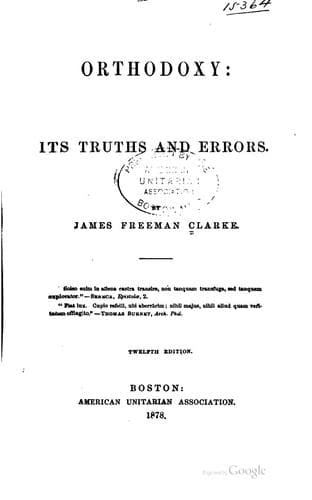
Orthodoxy: Its Truths And ErrorsClarke, James Freeman
Religion
Orthodoxy: Its Truths And Errors
Clarke, James Freeman
Unitarianism
They _saw_ the love of God in him;
they felt it in their hearts; they reposed on it undoubtingly. In
quietness and confidence was their strength. O, happy days! in which men’s
minds had not yet been harassed by thousands of vain controversies and
empty verbal disputes; by questions, and strifes of words; by most
profound theological discussions, ending in nothing but weariness; but
were satisfied, that, if men would go to Christ, they would find truth. O,
happy time! in which men had not learned to dissect their own hearts, and
pry curiously into their feelings, and torture themselves by anxious
efforts to _feel_ right, and tormenting doubts as to whether their inward
experiences were as they ought to be, but believed that all good feelings
would come in their own time out of Christian faith. O, happy, golden
hour! when love, and joy, and duty were all one; when men did not
prescribe for themselves and others a task-work, an outward routine of
duties; but had confidence, that, if they lived in the Spirit, they would
also walk in the Spirit.
That hour of simple, child-like faith passed away. Its decay appeared in a
return to the old mode of justification. Instead of simply relying on what
God had done, men must do something themselves to atone for their sins;
they must do penance, and have priests, and sacraments, and masses, and
countless ceremonies to come between them and God; they must pile up a
cumbrous fabric of religious and moral works, by which to climb up to God;
until, at last, though the doctrine of justification by faith was never
given up, it was made of none effect by the rubbish of human ceremonies
heaped before it. And then came Luther, armed with the old doctrine, to
sweep these all away, and call men back to the simple faith in the
Saviour. The pure word of faith went forth through all lands, conquering
and to conquer.
But there is a continual tendency to fall back again from faith upon
works. Ever as the life of religion weakens, ever as the strength of holy
confidence decays, men betake themselves to some outward forms or efforts.
When they cease to lean on the love of God, they begin to lean on
sacraments and ceremonies, on opinions and doctrines, on feelings and
experiences, on morality and works of duty. Ever, as the cold winter of
worldliness and sin causes the stream of holy faith to shrink back into
its channel, the ice of forms accumulates along its shores; and then, as
the inevitable consequence and sign of the decay of faith, we find the
Church becoming anxious and troubled, confidence giving way to anxiety,
cheerfulness to gloom, hope to fear. Everything terrifies the unbelieving
Church; new opinions terrify it; new measures terrify it. It has ashes
instead of beauty, mourning for joy, the spirit of heaviness instead of
the garment of praise.
§ 9. Orthodox Errors, at the present Time, in Regard to Justification by
Faith.
Public-domain text, read in full here on John Shaqi.
Reviews
Reviews
No reviews yet
Be the first to share your thoughts on this work.
Elsewhere in the archive
Join the Discussion
Join the discussion
Sign in to leave a comment or review.
Sign InorCreate an account