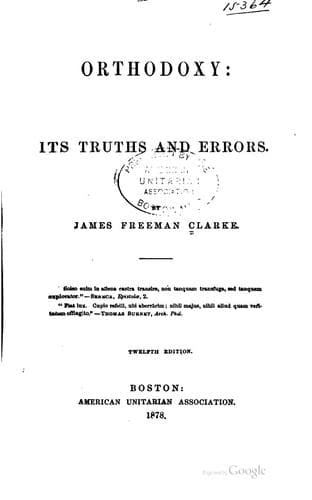
Orthodoxy: Its Truths And ErrorsClarke, James Freeman
Religion
Orthodoxy: Its Truths And Errors
Clarke, James Freeman
Unitarianism
That faith is not a mere emotion, in which we are wholly passive, appears
from such cases as those where men are exhorted to believe, as a thing in
their own power.
3. WORKS, in this doctrine, include every effort to reconcile God by
offering him anything in expiation of our sin, whether sacrifices,
sacraments, the assent to creeds, the struggle after feelings and
experiences, or reformation of character.
And the whole doctrine of justification by faith may be thus expressed:—
If you are burdened with a sense of unworthiness and guilt; if something
seems to separate your heart from God; if you want confidence to come to
him boldly in prayer,—do not try to remove this difficulty by any effort
to do something different, or become something different; but simply look
at Jesus in his sufferings and death, and see your heavenly Father calling
you to him _now_ to be forgiven. Go at once to God through Christ. Repose
on that love that will cleanse you, that will save you; and nevermore
doubt, even in your darkest hour, that your Father is ready to hear, to
forgive, and bless you.
§ 8. Its History in the Church.
We have seen the origin, nature, and value of this doctrine. Let us now
look at its history.
The apostolic Church was founded on the simple doctrine of faith in
Christ. It was not founded on any theory or speculation _about_ Christ, or
about his plan of salvation, but on _Christ himself_ as the Saviour. All
that the first Christians professed was faith in Jesus as the Son of God.
They had been reconciled to God by him; they were at peace with God; they
were washed in the blood of the Lamb; and they were happy. A deep and
wonderful joy brooded over the early church. A hurricane of persecution
and war raged around them: within the Church, all was security and peace.
How beautiful are the expressions by which the apostles describe the
serenity and joy of the Church! “They ate their meat in gladness and
singleness of heart, praising God, and having favor with all the people.”
New converts “gladly received the word, and were baptized” by thousands,
in the face of the bitterest persecution. “The multitude of them that
believed were of one heart and one soul; neither said any of them, that
aught of the things that he possessed was his own.” Whence came all this
peace and union in the early Church? Was it because they had attained to
such clear views of truth, and all held the same opinions? So far from it,
some had not heard that there was a Holy Ghost; others did not believe in
a resurrection of the dead; and many thought the whole Jewish ritual
essential to salvation. Was it that they had become suddenly pure in
heart, and holy in life, and freed from sin? So far from it, we find the
apostles exhorting them against very great vices,—against murder, theft,
and licentiousness,—and condemning them for having practised gross
immoralities. It came from the simplicity of their faith. They looked to
Jesus, and their faces were lightened.
Public-domain text, read in full here on John Shaqi.
Reviews
Reviews
No reviews yet
Be the first to share your thoughts on this work.
Elsewhere in the archive
Join the Discussion
Join the discussion
Sign in to leave a comment or review.
Sign InorCreate an account