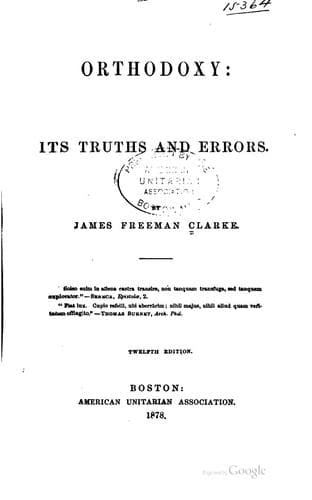
Orthodoxy: Its Truths And ErrorsClarke, James Freeman
Religion
Orthodoxy: Its Truths And Errors
Clarke, James Freeman
Unitarianism
It may be objected that it is dangerous to religion to admit that we can
be justified before we have believed certain important doctrines or
experienced certain peculiar feelings. It may also be objected, on the
other hand, that it is dangerous to morality to suppose that pardon can
precede reformation. But the more we read the Scriptures, the more we look
into our own heart, and the more we become acquainted with our fellow-men,
the deeper is our conviction, that there is but one source of true piety
and sound morality—a heart reconciled to God, and at peace with him. We do
not undervalue correct belief, deep feeling, or active obedience; but we
place them where they belong. They are the fruit of the tree, not the root
of the tree. The root and source and beginning of all piety and holiness
is simple faith in God through Christ. We must ask ourselves, therefore,
first of all, “Are we reconciled to God, or are we not? Are we living in
filial communion with him, or living without him in the world?” If
unreconciled, we must not think to work ourselves up into a degree of
goodness or pious feeling without God. There is no strength where there is
no confidence, where there is nothing to lean on, where there is
hollowness within. We ought to come at once to God. We ought to lift our
hearts to him, not saying, “Who shall go up to heaven for us, to bring him
to us? Who shall go over the sea for us?” For his word is very nigh, in
our mouth and heart.
The above discussion will show what we consider to be the truths, and what
the errors, in the Orthodox view of justification by faith.
CHAPTER X. ORTHODOX IDEA OF THE ATONEMENT.
§ 1. Confusion in the Orthodox Statement.
The subject of this chapter is the Orthodox doctrine of the work of
Christ, and especially of the atonement.
No doctrine of Orthodoxy is more difficult to state to the satisfaction of
the Orthodox than this. The reason is, that there is no doctrine
concerning which the Orthodox differ so much among themselves. There is no
difficulty in stating the Orthodox doctrine of the Trinity; for this is
the same, or nearly the same, in the symbols of all the Orthodox sects.
The Roman Catholic doctrine of the Trinity is essentially the same with
that of the Presbyterian, Lutheran, Methodist, and Episcopal Churches. But
not so with the doctrine of Christ’s reconciling and atoning work. This
has taken every form in past history, and is altogether unsettled at the
present time. Usually, many views are mingled together in modern
Orthodoxy; and while all Orthodox teachers use the same language, speaking
of the death of Christ as “atonement,” “expiation,” “vicarious sacrifice,”
“sin-offering,” “substitution,” “satisfaction,” yet they connect with
these words very different ideas. Such is the testimony of an eminent
Orthodox divine, who speaks thus:—
Public-domain text, read in full here on John Shaqi.
Reviews
Reviews
No reviews yet
Be the first to share your thoughts on this work.
Elsewhere in the archive
Join the Discussion
Join the discussion
Sign in to leave a comment or review.
Sign InorCreate an account