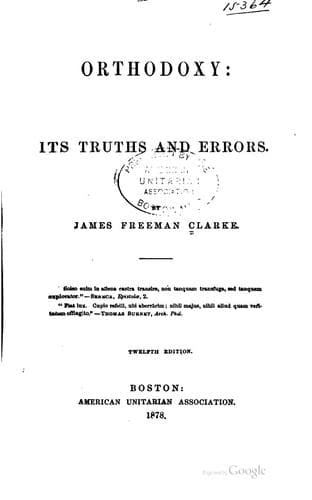
Orthodoxy: Its Truths And ErrorsClarke, James Freeman
Religion
Orthodoxy: Its Truths And Errors
Clarke, James Freeman
Unitarianism
“There is a general concurrence in the words _vicarious_, _expiation_,
_offering_, _substitute_, and the like, but no agreement as to the manner
in which they are to get their meaning. Sometimes the analogy of criminal
law is taken; and then our sins are spoken of as being transferred to
Christ, or he as having accepted them to bear their penalty. Sometimes the
civil or commercial law furnishes the analogy; and then, our sins being
taken as a debt, Christ offers himself as a ransom for us. Or the analogy
of the ceremonial law is accepted; and then Christ is set forth as a
propitiatory or expiatory offering to obtain remission of sins for us.
Regarding Christ as suffering for us in one or another of these Scripture
forms or figures taken as the literal dogmatic truth, we have as many
distinct theories. Then, again, different as these figures are from each
other, they will yet be used interchangeably, all in the sense of one or
another of them. And then, again, to double the confusion yet once more,
we have two sets of representations produced under each, accordingly as
Christ is conceived to offer himself to Jehovah’s justice, or as Jehovah
is conceived himself to prepare the offering out of his own mercy.
“On the whole, I know of no definite and fixed point on which the Orthodox
view, so called, may be said to hang, unless it be this, viz., that Christ
suffers evil as evil, or in direct and simple substitution for evil that
was to be suffered by us; so that God accepts one evil in place of the
other, and, being satisfied in this manner, is able to justify or pardon.
“As to the measure of this evil, there are different opinions. Calvin
maintained the truly horrible doctrine, that Christ descended into hell
when crucified, and suffered the pains of the damned for three days. A
very great number of the Christian teachers, even at this day, maintain
that Christ suffered exactly as much pain as all the redeemed would have
suffered under the penalties of eternal justice. But this penal view of
Christ’s death has been gradually giving way, till now, under its most
modern, most mitigated, and least objectionable form, he is only said to
have suffered under a law of _expression_.
Public-domain text, read in full here on John Shaqi.
Reviews
Reviews
No reviews yet
Be the first to share your thoughts on this work.
Elsewhere in the archive
Join the Discussion
Join the discussion
Sign in to leave a comment or review.
Sign InorCreate an account